Electrical Panel Upgrades in Burke, VA
Is Your Burke Panel a Federal Pacific or Zinsco? Here Is What to Do
Burke’s Kings Park subdivision was built in the 1960s — the era when Federal Pacific Stab-Lok panels were standard residential issue. Those panels have documented failure-to-trip rates that the CPSC investigated but never formally recalled. If your Burke home has one, Mohammed Salahuddin can identify the brand in five minutes and explain exactly what it means for your family’s safety.
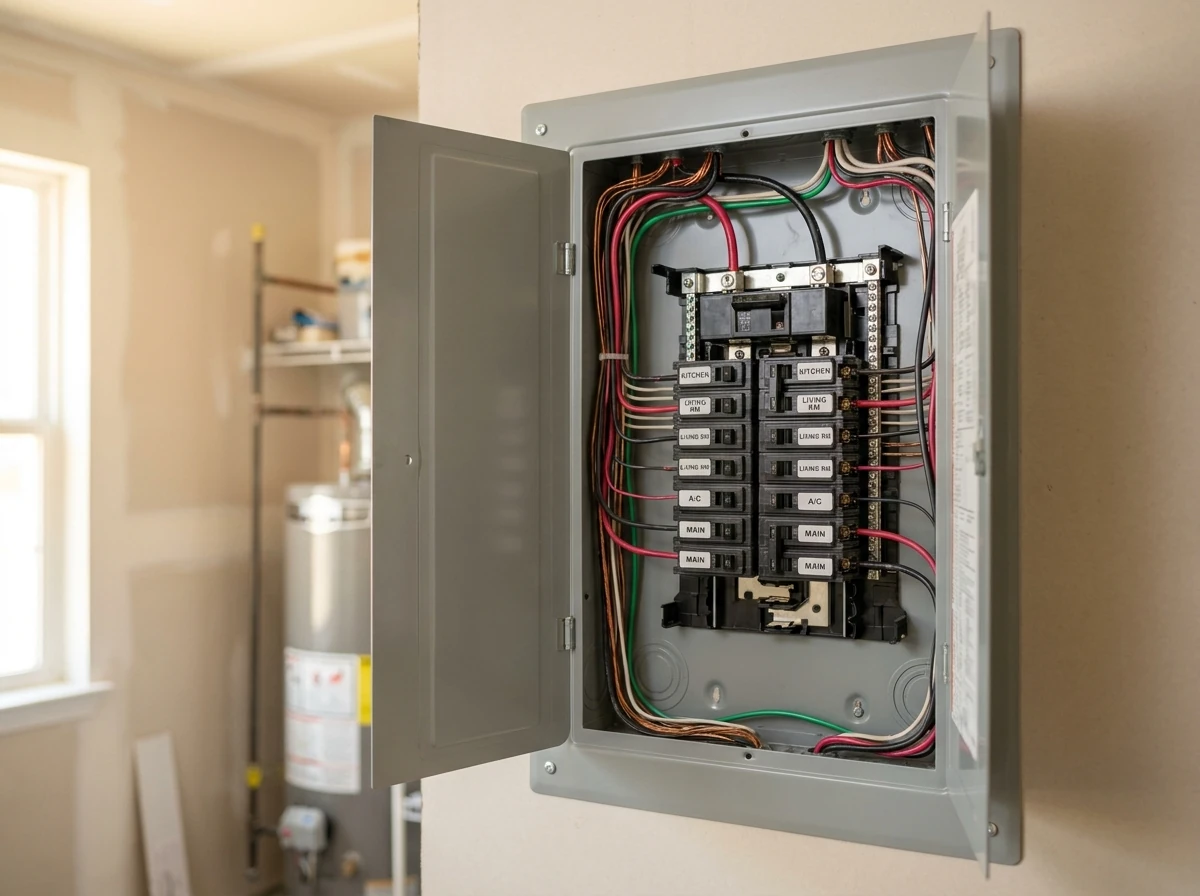
Federal Pacific and Zinsco: the panels we replace most often in Burke
Two panel brands dominate the 1960s housing stock in Burke’s oldest neighborhoods. Both have documented safety concerns that make replacement a priority regardless of symptoms.
Federal Pacific Stab-Lok
Fire riskFederal Pacific panels use Stab-Lok breakers with a documented failure-to-trip rate. When a circuit overloads, the breaker is supposed to trip and cut power. In tested FPE units, a measurable percentage fail to trip — the circuit stays live, the wire overheats, and the overcurrent has no protection. The CPSC investigated but never issued a formal recall. Many insurance carriers in Northern Virginia flag FPE panels at renewal.
Where in Burke: homes built in the 1960s in Kings Park, Kings Park West, and parts of Rolling Valley West may have FPE Stab-Lok panels. If your home was built in this era, check the panel door for the Federal Pacific or Stab-Lok brand marking.
Zinsco / GTE-Sylvania
Fire riskZinsco panels overheat at the bus-bar connection. The breakers can fuse to the bus bar over time, making them impossible to trip manually. Like FPE, the failure mode is loss of overcurrent protection — the panel cannot do the one job it exists to do. Zinsco panels were sold under the GTE-Sylvania and Sylvania brand names in some markets.
Where in Burke: same 1960s-era subdivisions. The brand is typically visible on the panel door or on the breaker handles themselves.
If your Burke home has either brand, replacement is the safety decision. We identify the brand on-site in five minutes — open the panel door, read the label, and tell you what you are looking at. The diagnostic visit is free.
Burke’s three housing eras and what each means for your panel
Burke is a built-out suburb — 88 percent of homes were built between 1960 and 1999. The median construction year is 1979. Each era has a different panel profile and a different set of concerns.
1960s: Kings Park — the FPE/Zinsco era
Kings Park, Kings Park West, parts of Rolling Valley West — ~8.6%100 amp panels, possibly Federal Pacific Stab-Lok or Zinsco brands. Cloth-insulated wiring in some builds, galvanized plumbing used as ground path, no GFCI anywhere. Some early-1970s construction in this zone may have aluminum branch wiring (common 1965-1972). These panels should be replaced regardless of symptoms — the fire-risk concern is the brand, not the age alone.
What fails: breakers that do not trip under overload (FPE), breakers fused to the bus bar (Zinsco), overloaded 100A service on modern loads. Insurance carriers flag at renewal.
1970s-1980s: Burke Centre — the volume era
Burke Centre (Woods, Oaks, Commons, Ponds, Landings), Signal Hill, Lake Braddock, Rolling Valley — ~67%150 to 200 amp panels (200 standard by mid-1980s). Original panels now 35 to 55 years old. Breakers aging beyond design life — the trip mechanism wears with each thermal cycle. GFCI present at bathrooms in 1980s builds, often absent at 1970s kitchens. Burke Centre alone has 5,862 residences across five neighborhoods — this is the concentrated demand pool for panel assessment and breaker replacement.
What fails: worn breaker trip mechanisms, degraded bus-bar connections after decades of thermal cycling, capacity insufficient for added EV chargers and heat pumps. Not a brand safety issue — an aging infrastructure issue.
1990s: Cherry Run and Edgewater — approaching assessment
Cherry Run, Walden at Burke Centre, newer Signal Hill, Edgewater — ~21%200 amp panels, GFCI at bathrooms and kitchens, no AFCI (pre-NEC 2008). These panels are 25 to 35 years old — approaching the threshold where breaker assessment becomes relevant. HOA approval may be needed for visible panel-related exterior work in some communities. Main concern: capacity assessment for added loads and breaker replacement if thermal cycling has degraded the trip mechanism.
What drives the cost of a panel upgrade in Burke
The most-asked question, and the answer depends on what is in your panel and what era your home was built.
- Panel brand: replacing a Federal Pacific or Zinsco panel is more involved than a standard upgrade. The bus bar may be degraded, breakers may be fused in place, and the panel enclosure itself may need replacement. This adds diagnostic and cleanup time beyond a standard swap.
- Current amperage: upgrading from 100A (Kings Park era) to 200A involves more scope than refreshing an existing 200A panel (Burke Centre era). The service-entrance conductors, meter base, and grounding system all scale with the amperage jump.
- Overhead vs. underground service: 1960s Kings Park and Rolling Valley West have predominantly overhead service from utility poles. 1990s Cherry Run and Edgewater have underground from pad-mount transformers. Underground may add scope if the lateral needs attention.
- Dominion Energy coordination: every panel upgrade needs a meter pull. Dominion schedules this on a 1 to 3 business day appointment window. All of Burke is on Dominion — no utility ambiguity.
- Code-triggered upgrades: opening a 1960s panel often reveals wiring or grounding that does not meet current NEC 2020. We address what the code requires and itemize it separately so you see the distinction between the panel work and the code work.
Five panel calls we get every week from Burke homeowners
Each symptom traces to a specific era and neighborhood. Here is what we see and what it means.
FPE breaker does not trip despite overload
Kings Park, 1960s
The circuit is overloaded but the breaker stays closed. No protection. The wire is carrying current beyond its rating, generating heat. This is the documented Federal Pacific Stab-Lok failure mode — the breaker physically cannot trip. If you have an FPE panel and have never had a breaker trip, that is not good luck — it may be a breaker that cannot trip. Call us immediately if you suspect this.
Panel warm to touch, breaker feels hot
Burke Centre Oaks / Ponds, 1980s
35 to 45 year old breakers with degraded contacts. The bus-bar connections loosen over time as thermal cycling expands and contracts the metal. Resistance increases at the connection point, generating heat. The breaker handle itself feels warm. This is active degradation — not an emergency yet, but it is heading that way. Call us if the panel smells like burning or is too hot to touch.
Warm outlet, discolored cover plate
Rolling Valley West, 1960s-1970s split-levels
Aluminum-to-copper junction corrosion at the receptacle. Homes built between 1965 and 1972 may have aluminum branch wiring. The aluminum oxidizes at every connection point, increasing resistance and generating heat. You see it first as a discolored or warm cover plate. This is a fire risk that progresses — the connection fails under load, not at rest.
Kitchen GFCI absent, shock risk near water
Signal Hill, 1970s builds
No ground-fault circuit interrupter at kitchen counter receptacles. The NEC required GFCI at kitchen counters starting with the 1987 code cycle. Many 1970s Burke kitchens predate this requirement. A fault near running water without GFCI protection is a shock hazard. Fix: GFCI retrofit at all code-required locations as part of a panel assessment.
Home-office circuit trips with monitors and space heater
Cherry Run, 1990s
A 15-amp circuit overloaded by modern home-office equipment — multiple monitors, printer, desk lamp, plus a space heater drawing 12.5 amps on its own. Thirty percent of Burke residents work from home at least part-time. The circuit was designed for a table lamp and a clock radio. Fix: dedicated 20-amp home-office circuit from the panel, which may require a capacity assessment if the panel is already full.
Can you upgrade your Burke panel without rewiring?
The answer depends on the era and the wiring behind the walls.
Usually no rewire needed
- 1970s-1980s Burke Centre (copper wiring): copper PVC-insulated wiring in good condition. The panel swap is standalone — new panel, new breakers, re-landed circuits, same wiring. This is the majority of Burke.
- 1990s Cherry Run / Edgewater: modern wiring, modern grounding. Panel replacement or breaker swap only.
Rewire likely or possible
- 1960s Kings Park (cloth-insulated wiring): the original wiring insulation is brittle after 60 years. A panel upgrade will uncover connections that current code requires you to address at the panel and possibly at the service entrance.
- Early 1970s Rolling Valley West (possible aluminum wiring): aluminum branch wiring from the 1965-1972 era requires special remediation at every connection — COPALUM or AlumiConn connectors approved for aluminum-to-copper junctions. This is not optional.
We determine which category your home falls into during the diagnostic visit. The estimate reflects the actual scope.
Insurance and real estate: why your panel brand matters at renewal and sale
In Burke, a panel upgrade is not just an electrical decision — it has insurance and real-estate implications that affect your most valuable asset.
- Insurance renewal: many carriers writing homeowner policies in Northern Virginia flag Federal Pacific and Zinsco panels during underwriting review. Some will not renew without a replacement. Others increase the premium or add exclusions for electrical fire claims. If your Burke home has either brand, the conversation with your carrier is coming — a preemptive replacement removes the leverage.
- CPSC history: the Consumer Product Safety Commission investigated Federal Pacific panels and found failure-to-trip rates in tested Stab-Lok breakers. The investigation did not result in a formal recall, but the documented failure data is part of the public record and is cited by insurers, home inspectors, and real-estate appraisers.
- Real estate transaction impact: Burke’s median home value is approximately $747,700. When a buyer’s inspector identifies an FPE or Zinsco panel, it becomes a negotiation point. Sellers who replace the panel before listing eliminate this item. Buyers who inherit the panel inherit the insurance conversation. The cost of a panel upgrade is a fraction of the negotiation exposure on a home at Burke’s price point.
- Appraisal notes: real-estate appraisers in Fairfax County increasingly note FPE and Zinsco panels as adverse conditions. While it may not directly reduce the appraised value, it gives the buyer’s agent leverage to request a credit or concession. A permitted modern panel with a county inspection record removes the issue entirely.
- Documentation we provide: after a panel replacement, we provide the Fairfax County inspection pass record, the new panel make and model, the permit number, and a photo of the completed installation. This is the documentation your insurance carrier and your real-estate agent need.
Permits in Burke — Fairfax County PLUS system
Burke is an unincorporated CDP within Fairfax County. All permits go through the county — no town-level overlay to navigate.
Fairfax County Department of Land Development Services — Building Division
Online filing: PLUS system at plus.fairfaxcounty.gov
URL: fairfaxcounty.gov/landdevelopment/
- Permit required: panel upgrades, new circuits, wiring modifications, EV charger circuits
- Code: Virginia 2020 NEC effective January 18, 2024; 2021 USBC effective January 18, 2025
- Same process as Springfield: both are unincorporated Fairfax County CDPs with the same permit path and the same inspectors
We pull the permit via PLUS, schedule the inspection, and handle the Dominion Energy meter-pull coordination. You do not visit the permit office or call the utility.
About Mohammed Salahuddin — Master Electrician
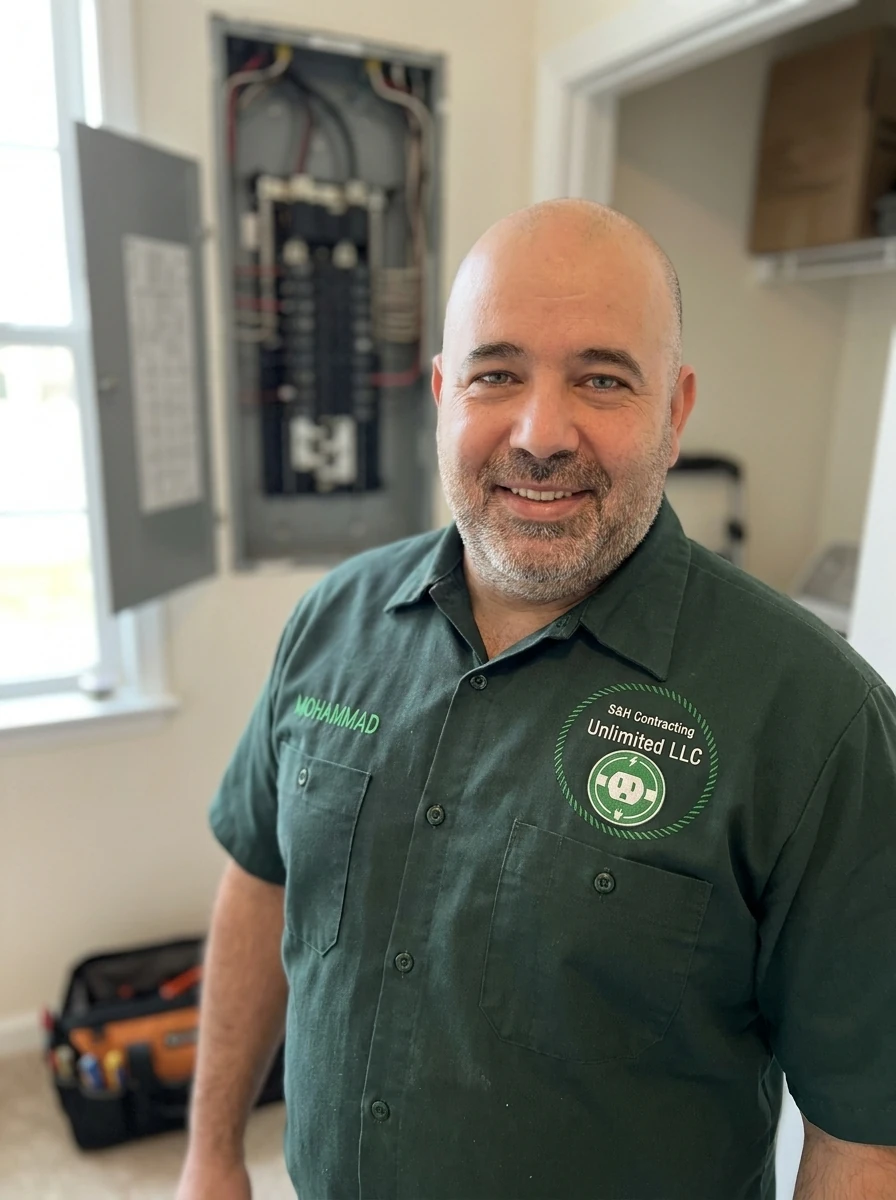
Mohammed Salahuddin holds a Virginia Master Electrician license — the highest tier the state issues. Sixteen-plus years in the trade, covering residential and commercial panel work across Northern Virginia. He runs a fully insured maintenance team out of Woodbridge, which puts Burke approximately 20 miles and 30 to 40 minutes away.
Burke has a local competitor — PAL Electrical Contractor ranks #3 on the SERP and appears to be Burke-based. That is a real proximity advantage S&H cannot match. What S&H offers instead: a Master Electrician credential (the highest Virginia license tier), a 5.0 perfect review record, and the diagnostic-first approach that means you get an honest assessment before a quote. Half the time, what looks like a full panel replacement turns out to be a worn breaker or a load-balance issue that costs far less.
S&H Contracting Unlimited is rated 5.0 stars across 77 Google reviews (re-verify count at publish time). Read more about our team.
Burke neighborhoods we serve
- Kings Park / Kings Park West — 1960s; FPE/Zinsco panel concentration, cloth-insulated wiring possible
- Burke Centre Woods — 1970s-1980s; 5,862 residences across 5 neighborhoods; 35-55 year old panels
- Burke Centre Oaks — 1980s; same aging-breaker profile as Woods
- Burke Centre Commons / Ponds / Landings — 1980s; the rest of the Burke Centre concentration
- Signal Hill — 1970s-1980s; mixed panel ages, GFCI gaps in 1970s kitchens
- Rolling Valley West — 1960s-1970s split-levels; possible aluminum wiring (1965-1972 era)
- Lake Braddock — 1970s-1980s; aging panels, same profile as Burke Centre
- Cherry Run — 1990s; panels approaching assessment age
- Edgewater — 1990s; underground service, modern wiring
We also serve Woodbridge, Alexandria, Manassas, and the broader Northern Virginia region.
Related electrical services
A panel upgrade often connects to other electrical work. If you need emergency service or an EV charger, we handle those too.
Panel upgrade questions — Burke, VA
What is the average cost of an electrical panel upgrade?
The cost depends on what is in your panel now. Replacing a fire-risk brand (FPE, Zinsco) is more involved than a standard panel refresh because the bus bar may be degraded and the breakers may be fused in place. Other variables: current amperage, overhead vs. underground service, and code-triggered upgrades. We do not publish a flat rate — the only honest number comes from opening the panel. Call 703-972-5571 for a free diagnostic at your Burke home.
How much should a 200 amp panel upgrade cost?
A 100A to 200A upgrade includes the new panel, new breakers, service-entrance conductor upgrade, meter base if needed, and Dominion Energy coordination. In Burke, the panel brand adds a variable — FPE or Zinsco replacement involves more cleanup work than replacing a standard panel. The written estimate breaks out every component so you see exactly what you are paying for.
Who can upgrade my electrical panel?
In Virginia, a panel upgrade must be performed by a licensed electrical contractor and inspected by the local authority. In Burke, that means a contractor licensed by DPOR (Virginia Department of Professional and Occupational Regulation) and an inspection by Fairfax County. Mohammed Salahuddin holds a Master Electrician license — the highest tier Virginia issues. We pull the Fairfax County permit and schedule the inspection as part of the project.
Is a Federal Pacific panel dangerous?
Federal Pacific Stab-Lok breakers have documented failure-to-trip rates in tested units. The CPSC investigated but did not issue a formal recall. The practical risk: a breaker that does not trip under overload means the circuit has no protection against overcurrent — the wire overheats with no mechanism to stop it. Many insurance carriers in Northern Virginia flag FPE panels at renewal or will not insure homes with unmitigated Stab-Lok panels. If your Burke home has one, replacement is the safety decision.
Does my insurance cover a panel upgrade?
Homeowner insurance typically does not cover elective panel upgrades. However, if your carrier has flagged your FPE or Zinsco panel as a condition of renewal, the replacement becomes a requirement rather than an elective improvement. Some carriers will apply a discount or credit after the replacement is documented. We provide the Fairfax County inspection record and panel documentation for your carrier.
Do I need a permit for a panel upgrade in Fairfax County?
Yes. Fairfax County requires an electrical permit for panel upgrades. Burke is an unincorporated CDP within Fairfax County — permits go through the county’s PLUS system at plus.fairfaxcounty.gov. We pull the permit, schedule the inspection, and handle the Dominion Energy coordination.
How long does a panel upgrade take in Burke?
Most residential panel upgrades are a one-day job. Dominion pulls the meter in the morning, we swap the panel and re-land every circuit, Dominion reseats the meter after inspection. Expect 4 to 6 hours without power during the swap. FPE or Zinsco replacement may add time if breakers are fused to the bus bar and require careful removal.
Ready to upgrade your Burke panel?
Free diagnostic visit. FPE and Zinsco identification in five minutes. Written estimate before any work starts. Fairfax County permit, Dominion coordination, and inspection handled from start to finish.
703-972-5571