EV Charger Installation in Lorton, VA
Level 2 EV Charging, Installed Right
Mohammed Salahuddin is a Virginia-licensed Master Electrician who installs Level 2 EV chargers across Lorton and surrounding areas. We assess your panel, run the dedicated 240V circuit, mount your charger, and handle the permit — so you wake up to a full charge instead of waiting all weekend on a trickle outlet.
What “EV charger installation” actually means
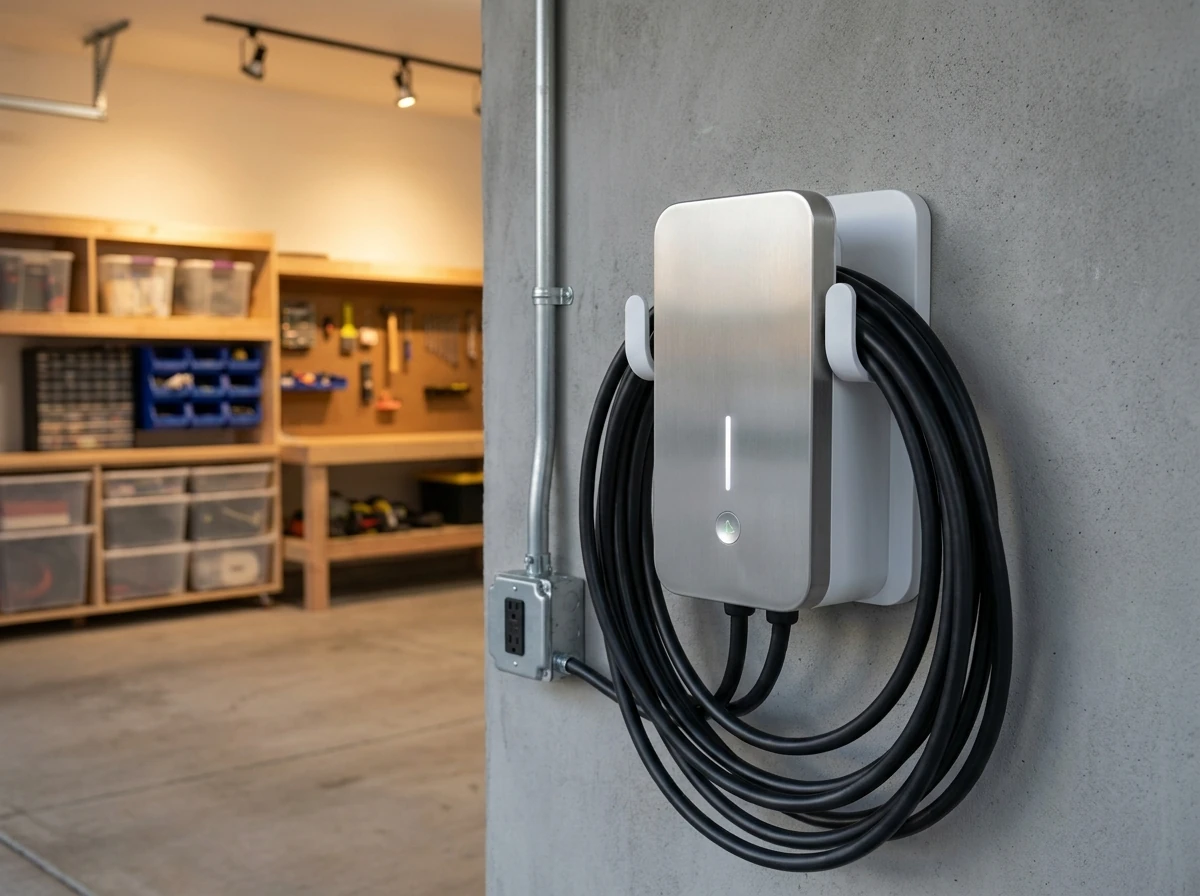
EV charger installation means adding a dedicated 240V circuit to your home so your car charges at 25-30 miles of range per hour instead of the 4-5 miles you get from a standard 120V outlet. That standard outlet is Level 1 — fine for a plug-in hybrid you drive ten miles a day, but not practical for a battery-electric vehicle. Level 2 is the dedicated circuit. The charger manufacturer builds the hardware; the licensed electrician installs the circuit, mounts the unit, and makes sure your panel can carry the load safely.
A Level 2 circuit runs on 240 volts at 40-50 amps continuous draw. Some chargers plug into a NEMA 14-50 outlet — the same receptacle a clothes dryer uses — while others, like the Tesla Wall Connector, are hardwired directly to the circuit with no plug at all. Hardwired units deliver higher amperage (up to 48A on the Tesla Wall Connector) and require a dedicated 60-amp breaker. Before any installation, we run a load calculation on your panel to confirm it can support the new circuit without tripping or overloading existing breakers. Most jurisdictions require a permit for the new 240V line.
When you call S&H Contracting for an EV charger install, Mohammed Salahuddin — a Virginia-licensed Master Electrician with 16+ years in the trade — handles the panel assessment personally. He reads the panel, identifies open breaker slots, calculates the load, and tells you straight whether you need an upgrade or whether your existing panel has room. That diagnostic-first approach is how every EV charger job starts in Lorton and across the service area. The charger goes on the wall only after the electrical side checks out.
Why Lorton homeowners call us for EV charger installation
Lorton, VA sits in southern Fairfax County where I-95 meets the Occoquan River, adjacent to Fort Belvoir and the Mason Neck peninsula. The community runs roughly between Springfield to the north, the Prince William County line to the south, Fort Belvoir to the east, and the I-95 corridor to the west. Lorton is 10-15 minutes from Springfield, 20-30 minutes from Alexandria, and 30-45 minutes from downtown DC, depending on traffic.
1960s-1970s ranches & split-levels
Pohick Estates, Gunston area, parts of Lorton ValleyLorton’s oldest significant housing cluster. Built with 100-amp panels (sometimes original Federal Pacific or Zinsco brands), cloth-insulated or early thermoplastic copper wiring, galvanized steel supply plumbing running to copper at fixtures, and minimal insulation (R-13 walls at best). Central AC was an afterthought — many had window units only. Fast-forward to 2026: these homes now run modern loads (central AC, multiple refrigerators, home offices, EV chargers) on circuits the original builder never planned for. Panel upgrades and rewiring are common needs in this stock.
Symptoms: 60-100A panels with circuits sized for 1960s-70s loads; possible Federal Pacific or Zinsco panels; fuse boxes in some units; overhead service in non-HOA areas; frequent breaker trips when modern appliances run simultaneously; insurance carriers flagging FPE/Zinsco at renewal.
1980s-1990s colonials & planned communities
Crosspointe, Newington Forest, South Run area, parts of Lorton Valley200-amp service became standard in this era. Wiring is copper with PVC insulation; GFCI (ground-fault circuit interrupter) protection is present at bathrooms but may be absent at kitchen counters in pre-1996 builds (NEC 1996 made kitchen-counter GFCIs mandatory). Plumbing is mostly copper with early PEX (cross-linked polyethylene) appearing in the 1990s builds. Central AC is standard. Many of these neighborhoods have HOAs that add an approval layer for visible exterior work like generator pads or EV charger installations.
Symptoms: 200A panels standard at construction; upgrades here are about adding capacity — EV charger circuits, home office loads, hot tub wiring; AFCI breaker nuisance-tripping on noisy loads; HOA coordination may be needed for visible exterior panel work.
2000s-2020s newer construction — Laurel Hill era
Laurel Hill, Lorton Station, Liberty Crest, newer South Run subdivisionsThe dominant housing stock in Lorton — roughly 46% of all units were built after 2000. These homes meet modern code requirements: 200-amp panels, AFCI (arc-fault circuit interrupter — the breaker that detects dangerous electrical arcs) protection on bedroom circuits (NEC 2008) and most living-area circuits (NEC 2014+), tamper-resistant outlets, and PEX plumbing throughout. But newer doesn’t mean issue-free: AFCI breakers are sensitive by design and trip on noisy loads; smart-home wiring from a previous owner’s DIY project can cause neutral-bonding issues; and townhome electrical systems often share utility infrastructure that complicates individual upgrades. The Liberty Crest apartments are historic adaptive reuse (former prison buildings) with modern electrical but unique structural constraints.
Symptoms: 200A panels with modern wiring and AFCI/GFCI protection throughout; panel upgrades rare unless major home addition or whole-house electrification; underground service standard.
EV registrations in Lorton have been climbing year over year, and the electrical infrastructure in most homes here wasn’t built for a 40-50 amp continuous draw. That gap between the car in the driveway and the panel in the basement is why homeowners call.
EV charging situations we handle every week in Lorton
Here are the calls Mohammed gets most often from Lorton homeowners. If your situation matches one of these, you’re in the right place.
New EV, no Level 2 charger yet
You bought a Tesla, Rivian, BMW, Hyundai, or any other EV and realized the trickle charger on a standard 120V outlet adds 4-5 miles of range per hour. A dedicated 240V Level 2 circuit delivers 25-30 miles per hour — overnight charging instead of all-weekend charging. We install the circuit, mount the charger, and handle the permit.
Panel doesn’t have room for a 50-amp breaker
An EV charger draws 40-50 amps continuously. If your panel is 100-amp with a full breaker box, there’s no space to add the circuit without an upgrade. We assess whether you need a full panel upgrade to 200-amp or whether a sub-panel or load-management device is the right call.
Charger in a detached garage or outdoor parking spot
Running a 240V circuit from the main panel to a detached garage or carport requires an outdoor-rated conduit run, a sub-panel or disconnect, and weatherproof hardware. We size the feeder, trench or surface-mount the conduit, and install the charger with proper grounding.
Tesla Wall Connector installation
The Tesla Wall Connector is the most common charger we install. It’s hardwired (no plug), delivers up to 48 amps, and requires a dedicated 60-amp circuit. We mount it at the right height, run the circuit, and configure the Wi-Fi so you can monitor charging from the Tesla app.
Charger trips the breaker or throttles
If your existing charger throttles itself down or trips the breaker every few hours, the cause is usually upstream — an undersized circuit, a loose connection, or a panel that can’t sustain the continuous load. We diagnose the electrical cause, not the charger.
Multi-EV household — two chargers, one panel
Two EVs charging simultaneously can draw 80-100 amps. Most homes need a panel upgrade or a load-sharing device to handle this. We calculate the load, recommend the right solution, and install both circuits so neither car has to wait.
NEMA 14-50 outlet for a portable charger
Some homeowners prefer a NEMA 14-50 outlet (the same plug as a dryer) so they can use a portable Level 2 charger. It’s simpler and cheaper than a hardwired unit. We install the dedicated 50-amp circuit and the outlet, and you plug in your own charger.
Our EV charger installation process — what happens when you call
When you call 703-972-5571 or request a quote online, here’s what happens.
A real conversation about your setup
We ask about your vehicle (make, model, onboard charger amperage), your current panel (age, amperage, available slots), where you park (garage, driveway, street), and what charger you want. If you already bought the charger, we work with it. If not, we recommend one based on your car and your electrical capacity.
On-site assessment and written estimate
We come to the house, look at the panel, measure the distance to the charging location, and run a load calculation. You get a written estimate with the circuit, the conduit run, the charger mount, the permit fee, and the labor laid out clearly. No surprise pricing.
Permit and scheduling
Most jurisdictions require a permit for a new 240V circuit. We pull the permit, schedule the install, and coordinate with you on timing. Most installs are a half-day to full-day job depending on the run distance.
Installation — typically half a day
We install the breaker, run the circuit, mount the charger or outlet, and test the full system. For hardwired chargers, we configure the charger’s amperage setting and verify the app connection. You drive away charging that night.
Inspection and sign-off
The county inspector visits. We meet them, walk through the work, and they sign off. You get the permit and inspection record — important for your home insurance and for EV tax credit documentation.
How estimates work
Every EV charger installation starts with an on-site assessment — not a phone quote. We look at your panel, measure the run distance, and factor in the charger type before giving you a written estimate. You see the full number, broken out by line item, before any work begins.
- An on-site assessment comes first. We look at the panel, the run distance, and what you’re adding. You get a written estimate before any work starts.
- The estimate covers the breaker, the circuit run, the charger mount (if hardwired), the permit fee, and the labor. No add-ons on the work day.
- Panel upgrades — if your panel can’t support the new circuit — get a separate line item. You see what each piece costs.
- Tax credits: the federal EV charger tax credit (Section 30C) may cover up to 30% of installation costs. We don’t file it for you, but we give you the documentation your tax preparer needs.
We don’t post fixed prices because every installation is different — panel capacity, run distance, conduit type, permit fees. The estimate after a real on-site assessment is the only honest number.
About Mohammed Salahuddin, Licensed Electrical Contractor
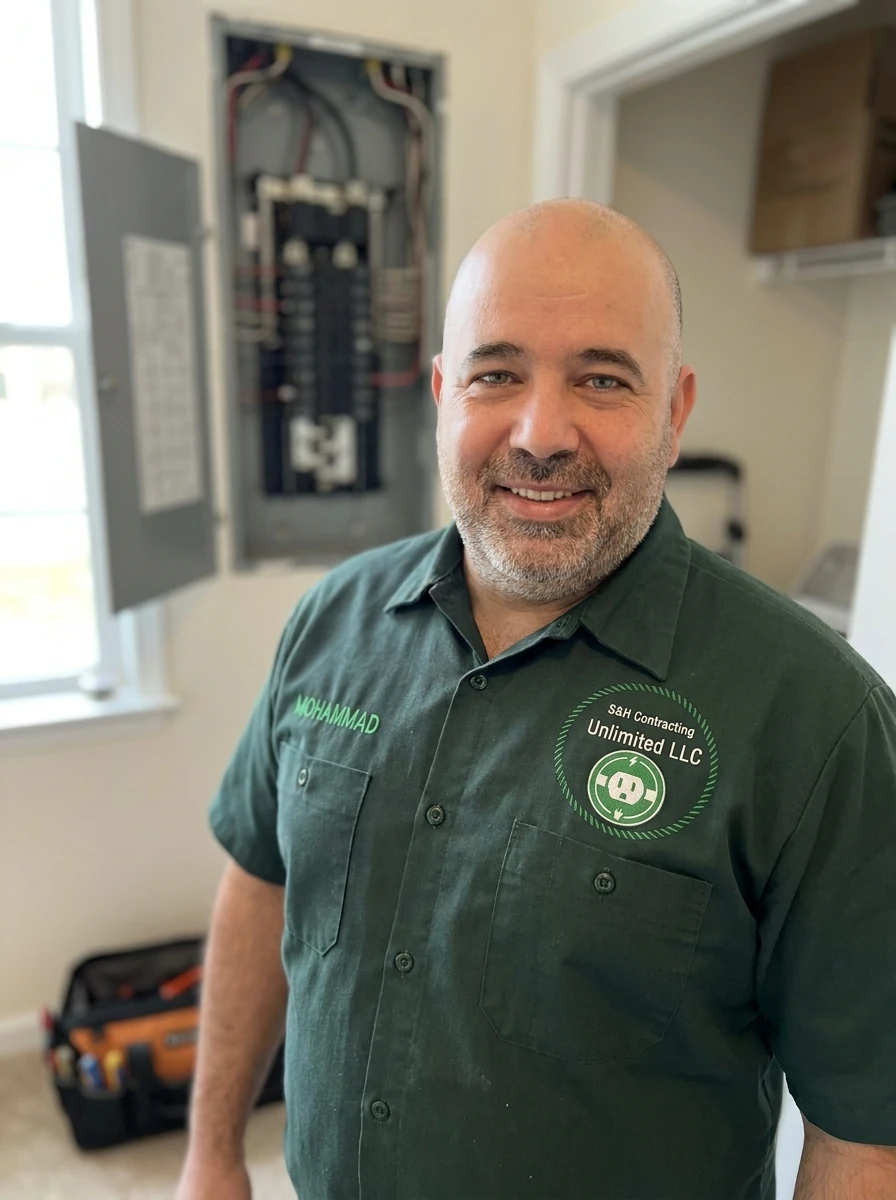
Mohammed Salahuddin holds a Master Electrician license in Virginia — the highest tier the state issues, requiring years of journeyman work and a passed state exam. He’s spent 16+ years doing residential and commercial electrical across Northern Virginia, DC, Maryland, and Pennsylvania, including a steady volume of EV charger installations — Tesla Wall Connectors, ChargePoint Home Flex units, Wallbox Pulsar Plus, and JuiceBox 40. S&H Contracting is fully insured and runs a maintenance team, so scheduling doesn’t hinge on one person’s calendar.
Mohammed Salahuddin is the one who shows up for the panel assessment on most residential EV charger jobs. He reads the panel, runs the load calculation, and explains in plain English whether your existing service can handle a new 40-50 amp circuit or whether an upgrade is the right move. That diagnostic happens before any quote — because quoting a charger install without seeing the panel first is guessing, and guessing costs the homeowner money downstream.
S&H Contracting Unlimited holds a 5.0-star average across 69 customer reviews. Real reviews from Northern Virginia, DC, and Maryland customers across residential and commercial jobs. 5.0-star average across 69 verified Google reviews.
Lorton neighborhoods we serve
We cover all of Lorton, VA, including:
- Laurel Hill — the master-planned community on the former prison grounds
- Lorton Station — townhomes and mixed-use near the VRE commuter rail stop
- Lorton Valley — established single-family homes along Lorton Road
- Crosspointe — large planned community with single-family homes and townhomes
- Newington Forest — split-levels and colonials off South Run Road
- Gunston area — homes near Gunston Road and the Mason Neck approach
- Pohick Estates — mid-century homes near the Pohick Creek corridor
- Mason Neck — semi-rural homes on the peninsula toward the Potomac
- South Run area — newer subdivisions near South Run District Park
Outside Lorton, we serve Springfield, Woodbridge, Burke, Fairfax Station, and the rest of southern Fairfax County. We also cover Alexandria, Dale City, Lake Ridge, and communities throughout Northern Virginia.
Related electrical services in Lorton
EV charger installations often uncover related electrical needs — a panel that’s at capacity, outdated wiring, or garage lighting that hasn’t been touched in decades. Here’s what else we handle in Lorton.
Frequently asked questions
How much does an EV charger installation cost in Lorton, VA?
The cost depends on three things: your panel’s available capacity, the distance from the panel to the charger location, and whether you need a panel upgrade. A straightforward garage installation where the panel has room for a new 50-amp breaker and the run is short is our most common job. Longer conduit runs, detached garages, or panels that need a heavy-up add to the scope. We don’t post fixed prices because no two homes are wired the same. Call 703-972-5571 and we’ll schedule an on-site assessment — you get a written, itemized estimate before any work starts.
Do I need a panel upgrade to install an EV charger?
It depends on your current panel amperage and how many breaker slots are open. If you have 200-amp service with available slots, you can usually add a 50-amp EV charger circuit without upgrading anything. If you have 100-amp service — common in homes built before the 1990s — the panel likely can’t sustain the additional continuous draw, and a heavy-up to 200 amps is the right move. We check this during the on-site assessment. A load calculation per NEC requirements tells us exactly how much capacity your panel has left. No guessing — real numbers from a real panel read.
What’s the difference between Level 1 and Level 2 charging?
Level 1 is the cord that comes with your car — it plugs into a standard 120V household outlet and adds about 4-5 miles of range per hour. For a battery that needs 250+ miles of charge, that’s 50-60 hours of wall time. Level 2 runs on a dedicated 240V circuit at 40-50 amps and delivers 25-30 miles of range per hour — a full overnight charge for most EVs. Level 2 is the setup most daily drivers need. There’s also Level 3 (DC fast charging), but that’s commercial infrastructure, not residential — it requires industrial-grade power that homes don’t carry.
Can you install a Tesla Wall Connector?
Yes — the Tesla Wall Connector is the most common charger we install. It’s a hardwired unit (no plug) that delivers up to 48 amps on a dedicated 60-amp circuit. We mount it at the manufacturer-recommended height, run the 6-gauge wiring from your panel, install the double-pole breaker, and configure the Wi-Fi connection so you can monitor charging through the Tesla app. The Wall Connector also charges non-Tesla vehicles that use the NACS connector — Ford, GM, and Rivian have adopted the standard. We also install ChargePoint Home Flex, Wallbox Pulsar Plus, and JuiceBox 40 if you prefer a universal J1772 unit.
Do I need a permit for an EV charger installation in Lorton, VA?
Yes. A new 240V circuit requires an electrical permit in every Northern Virginia jurisdiction we work in — Prince William County DDS, Fairfax County LDS, the City of Manassas permit desk, and others depending on your location. The permit ensures the work is inspected and meets NEC Article 625 requirements for EV charging equipment. We pull the permit, schedule the inspection, and meet the inspector on-site. You don’t have to call anyone or stand in line. The permit and inspection record also matters for your homeowner’s insurance and for documenting the installation if you apply for the federal EV charger tax credit.
How long does an EV charger installation take?
Installation day itself is typically 2-6 hours for a straightforward job — that covers installing the breaker, running the circuit, mounting the charger, and testing the full system. A short run from a panel with open slots and no obstacles is the faster end. A longer conduit run through finished walls, a detached garage trench, or a panel that needs a sub-panel addition pushes toward the full-day end. Add 1-3 weeks of lead time for permit processing in some jurisdictions before the install date. We schedule most installations within 5-10 business days of estimate acceptance.
Can I install an EV charger outdoors or in a detached garage?
Yes — both are common installations we handle. Outdoor mounts use a weatherproof NEMA-rated enclosure and GFCI protection per code. The charger itself is rated for rain, snow, and direct sun (most Level 2 units carry a NEMA 3R or 4 rating). For detached garages, we run a feeder from your main panel to a sub-panel or disconnect in the garage — either trenched underground in PVC conduit or surface-mounted depending on your property layout. The main cost variable is distance: a 50-foot run costs less than a 150-foot run. We measure the exact route during the on-site assessment.
Is there a tax credit for EV charger installation?
The federal Alternative Fuel Vehicle Refueling Equipment Credit (IRS Section 30C) covers 30% of the cost of purchasing and installing an EV charger at your primary residence, up to $1,000 for residential installations. The property must be in an eligible census tract — most of Northern Virginia qualifies. On top of that, Dominion Energy offers a $125 rebate for smart charger installation and an additional $40 per year if you enroll in their managed charging program. We don’t file the credit for you, but we provide the itemized invoice and permit documentation your tax preparer needs to claim it.
Ready to stop waiting on a trickle charge?
Call 703-972-5571 to schedule a panel assessment and get a written estimate for Level 2 EV charger installation in Lorton, VA.
We respond within one business day.