
WHY DOES MY BREAKER KEEP TRIPPING?
A Straightforward Troubleshooting Guide From a Licensed Electrician
Your breaker tripped again. Before you call anyone, read this. Some causes you can fix yourself in five minutes. Others need an electrician. This guide tells you the difference.
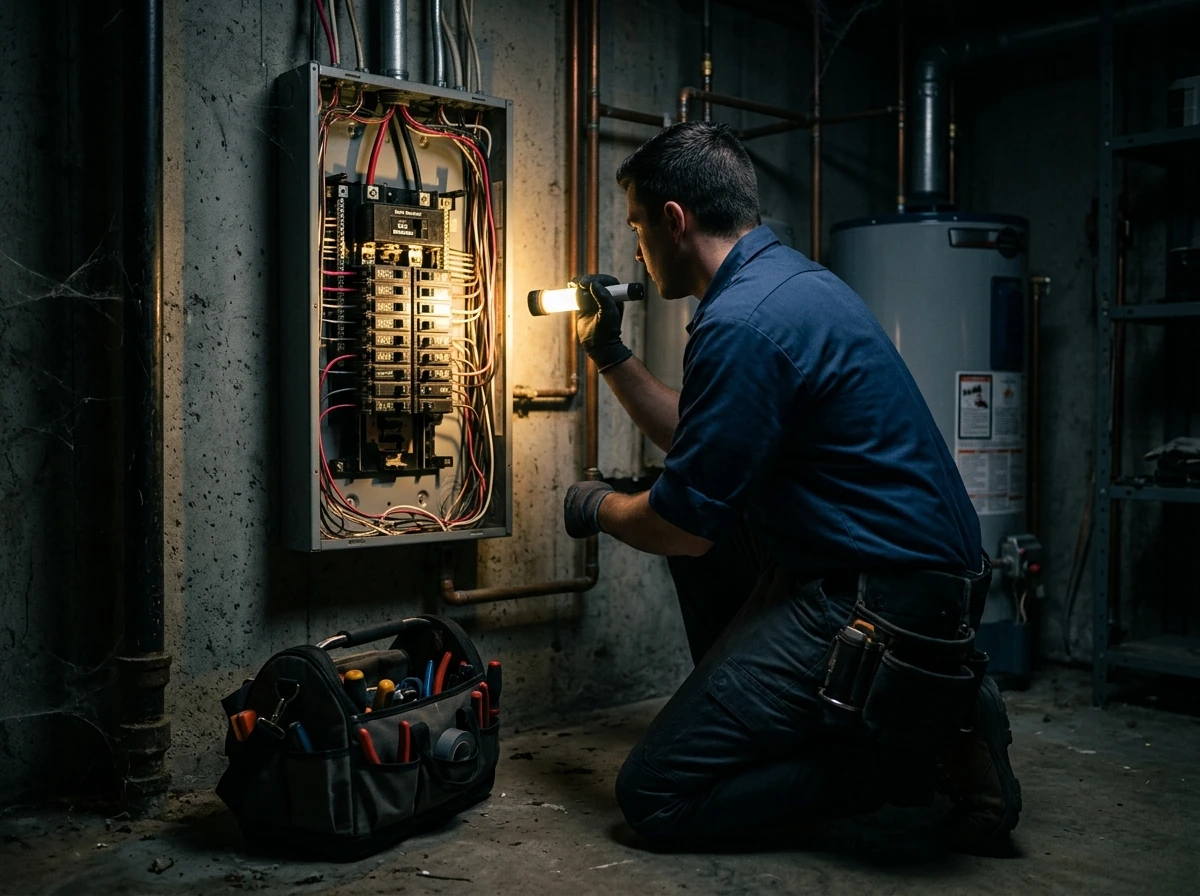
First: What a Breaker Actually Does
A circuit breaker is a safety device. When the current flowing through a circuit exceeds what the wire can safely carry, the breaker trips — it physically disconnects the circuit to prevent the wire from overheating and starting a fire.
A breaker that trips is doing its job. The problem is not the breaker. The problem is whatever is causing too much current to flow. Fix that, and the breaker stops tripping.
The 6 Most Common Causes — and What to Do About Each
Overloaded Circuit (Most Common — You Can Fix This)
You are drawing more power than the circuit is rated for. A standard 15-amp circuit handles about 1,800 watts. A 20-amp circuit handles about 2,400 watts. Add up what is plugged in: a space heater (1,500W) plus a hair dryer (1,800W) on the same circuit will trip a 15-amp breaker every time.
What to do: Unplug some devices from that circuit and move them to outlets on different circuits. If you are not sure which outlets share a circuit, turn off the tripped breaker and check which outlets lose power. Spread your high-draw appliances across different circuits.
When this needs an electrician: If you are constantly shuffling appliances because you do not have enough circuits, the house needs additional circuits run from the panel. This is common in homes built before 2000.
Short Circuit (Call an Electrician)
A hot wire is touching a neutral wire or a ground wire somewhere in the circuit. This creates a path of near-zero resistance, which draws a massive surge of current and trips the breaker instantly.
Signs: The breaker trips the moment you flip it back on (even with nothing plugged in), or you see a burn mark or smell something burnt at the panel.
What to do: Do not keep resetting the breaker. A short circuit can cause arcing inside the wall, which is a fire hazard. Call a licensed electrician to find and repair the fault.
Ground Fault (Call an Electrician)
Current is leaking from a hot wire to the grounding system, usually because of damaged insulation, water intrusion, or a failing appliance. This is especially common in kitchens, bathrooms, garages, and outdoor circuits.
Signs: The breaker trips when you use a specific appliance, or it trips intermittently in wet weather. If you have GFCI outlets in the area and they are not tripping first, the GFCI may be failed or missing.
What to do: If unplugging a specific appliance stops the tripping, the appliance has an internal ground fault — stop using it and have it repaired or replaced. If the tripping continues with everything unplugged, the fault is in the wiring and needs an electrician.
Arc Fault (Call an Electrician)
Damaged wiring is creating small electrical arcs — sparks jumping across gaps in damaged conductors. This can happen from a nail driven through a cable during remodeling, rodent damage, or wire insulation deteriorating with age.
Signs: An AFCI breaker (required in bedrooms and living areas in newer homes) trips seemingly at random, often without any obvious overload. Sometimes you hear a brief buzzing from an outlet or switch before it trips.
What to do: AFCI breakers are designed to detect exactly this kind of hazard. If yours is tripping, it is likely detecting a real problem. Have an electrician inspect the circuit. Do not replace an AFCI breaker with a standard breaker to “fix” the tripping — you are removing the safety device that is protecting you from a fire.
Bad Breaker (Call an Electrician)
Breakers wear out. After thousands of trips over 20–30 years, the internal mechanism weakens and the breaker starts tripping at lower currents than its rating. Or it fails to trip when it should, which is worse.
Signs: The breaker trips with a very light load — a single lamp or nothing at all. The breaker handle feels loose or does not snap firmly to the ON position. The breaker is warm or hot to the touch.
What to do: A breaker replacement is straightforward for a licensed electrician — typically under an hour. The hard part is making sure the replacement breaker is the correct type and amperage for the circuit and the panel. Using the wrong breaker voids the panel’s listing and is a code violation.
Appliance Drawing a Startup Surge (Try This First)
Some appliances — air conditioners, refrigerator compressors, sump pumps, older washing machines — draw 3–5 times their running current for the first fraction of a second when they start. If the circuit is already loaded near capacity, this startup surge trips the breaker.
What to do: Put the high-startup appliance on its own circuit if possible. If the breaker only trips when a specific appliance kicks on and nothing else is running, the appliance may need a dedicated circuit. This is a common and straightforward electrician job.
Quick Checklist Before You Call
Work through this before picking up the phone. If any step resolves it, you just saved yourself a service call.
- Unplug everything on the tripped circuit. Reset the breaker. If it holds, plug things back in one at a time. The one that trips it is your culprit — it is either overloading the circuit or has an internal fault
- Check for obvious damage. Scorch marks on outlets, burn smells from walls, warm or discolored outlet covers. Any of these = call an electrician, do not reset
- Count the load. Add up the wattage of everything on the circuit. Over 1,800W on a 15-amp circuit or 2,400W on a 20-amp? You are overloaded. Redistribute
- Check the breaker itself. Is the handle firmly in the OFF or TRIPPED position? Some breakers have a middle “tripped” position — push it fully to OFF first, then back to ON
- Check GFCI outlets. A tripped GFCI can kill power to downstream outlets without tripping the breaker. Press the RESET button on any GFCI outlets in the area
If the breaker trips immediately upon reset with nothing plugged in — you have a short circuit or ground fault in the wiring. Stop resetting and call an electrician.
When You Need an Electrician
Call if any of these are true:
Breaker Trips With Nothing Plugged In
The fault is in the wiring itself — a short circuit, ground fault, or damaged cable somewhere behind the wall. This requires diagnosis and repair by a licensed electrician.
Burn Marks, Smell, or Heat
Scorch marks on the panel, outlet, or wall. A burning smell. A breaker or outlet that is hot to the touch. These are signs of arcing or overheating — fire precursors. Do not reset.
The Same Breaker Trips Repeatedly
You have ruled out overload and it keeps happening. The breaker itself may be failing, or there is an intermittent fault in the circuit that needs professional diagnosis.
You Need More Circuits
If the only solution is to permanently redistribute appliances because your home does not have enough circuits, adding circuits is a licensed electrician job — it involves running new wire and adding breakers to the panel.
What Mohammed Does When He Gets There
Mohammed is a Virginia Master Electrician (#2710073974) with 16+ years of experience. Licensed in Virginia, Maryland, and DC. Here is what the service call looks like:
Panel Inspection
He checks the breaker, the connections at the bus bar, and the overall condition of the panel. He looks for signs of overheating, loose connections, and incorrect breaker sizing.
Circuit Diagnosis
Using a multimeter and circuit tracer, he identifies which segment of the circuit has the fault. He checks every junction box, outlet, and switch on the circuit.
Written Estimate
He explains what he found, what needs to happen, and what it costs. No work starts until you approve it.
He answers the phone 24 hours a day, 7 days a week: 703-972-5571.
Frequently Asked Questions
Is a tripping breaker dangerous?
The tripping itself is a safety mechanism — it is preventing something worse. But the underlying cause can be dangerous. A short circuit or ground fault left unrepaired can start a fire. If the breaker trips repeatedly, do not keep resetting it — find the cause.
Can I just replace the breaker with a higher-amp one?
No. The breaker is sized to protect the wire, not the appliance. A 15-amp breaker protects 14-gauge wire. Putting a 20-amp breaker on 14-gauge wire lets the wire overheat before the breaker trips — that is how electrical fires start. Never upsize a breaker without upsizing the wire.
Why does my breaker trip when I turn on the AC?
Air conditioners draw a large startup surge. If the AC is on a circuit with other loads, the combined draw during startup exceeds the breaker rating. The fix is usually a dedicated circuit for the AC unit. Some units also develop internal faults as they age that draw more current than normal.
My breaker trips in the rain. Why?
Water is entering the electrical system somewhere — an outdoor junction box with a failed seal, a buried cable with damaged insulation, or a roof leak dripping onto wiring in the attic. This is a ground fault and needs an electrician to locate and seal the entry point.
How old is too old for a circuit breaker?
Most breakers are rated for 25–30 years. After that, the internal mechanism weakens and they may trip nuisance or fail to trip when they should. Federal Pacific and Zinsco panels have well-documented failure rates regardless of age — if your home has one, get it inspected.
Related Services
Breaker Still Tripping?
If the checklist above did not solve it, call Mohammed. He will find the cause and give you a written estimate before any work starts. 24/7.
703-972-5571