Electrical Panel Upgrades in Alexandria, VA
Alexandria Panel Upgrades — Older Homes, Historic District Rules, and Three Different Utilities
Alexandria has the oldest housing stock and the most complex utility landscape in our service area. Nearly half the homes were built before 1970. Old Town’s Historic District adds Board of Architectural Review approval on top of the building permit. Mohammed Salahuddin is a Master Electrician who knows the difference between Alexandria’s permit office and Fairfax County’s — because Alexandria is its own independent city.
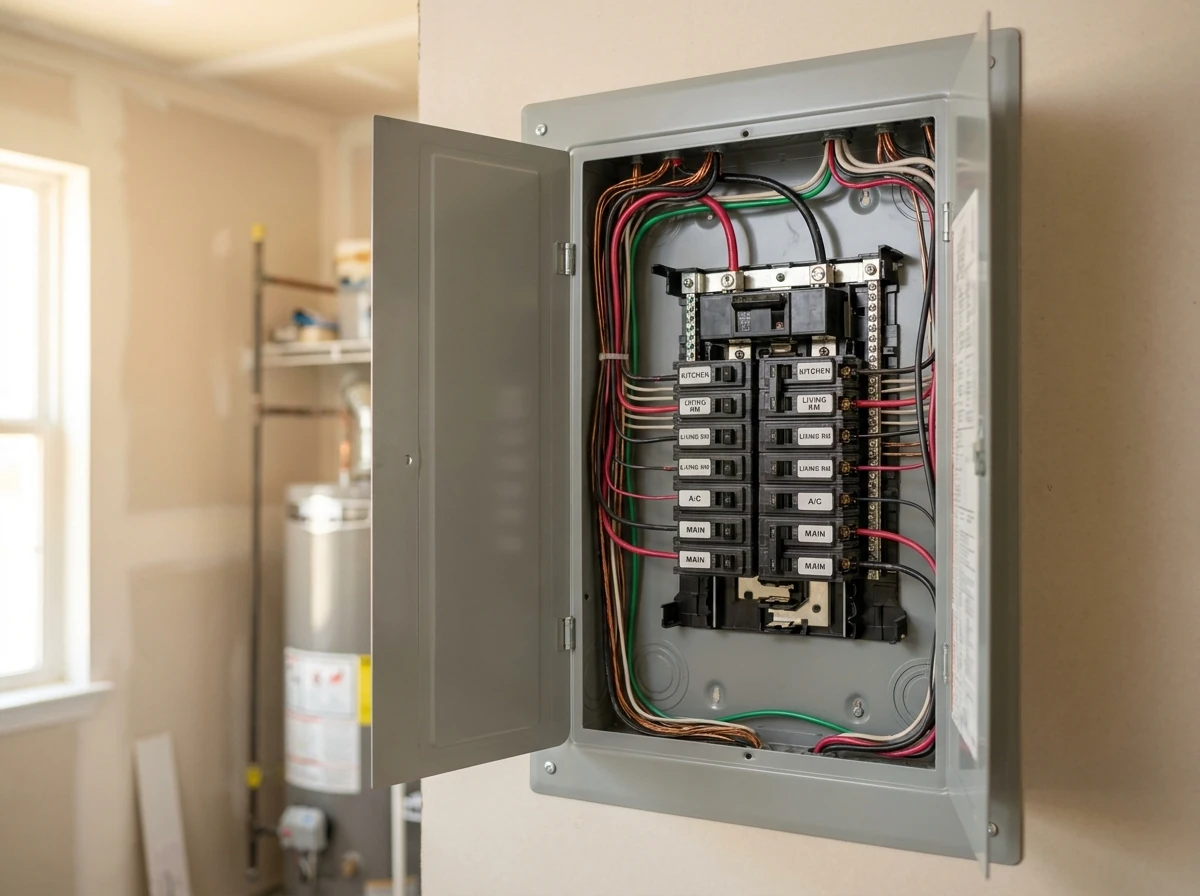
How much does a panel upgrade usually cost in Alexandria?
Alexandria is the most complex panel upgrade in our service area. Three factors drive the cost higher here than in Prince William County: the housing stock is older (median construction year approximately 1974), the Historic District adds a Board of Architectural Review step for exterior work in Old Town, and the utility landscape has more moving parts. Here is what makes Alexandria different.
- Older housing stock means more scope: 35.3% of Alexandria housing dates from the 1940s to 1960s — 60 to 100 amp panels with cloth-insulated wiring. The panel upgrade in these homes often includes partial rewiring. Pre-1940 Old Town homes with knob-and-tube wiring need full rewire alongside the panel.
- Historic District overlay: panel work in Old Town that involves exterior modifications visible from the street — conduit runs on the facade, panel relocation, solar panel mounting — triggers Board of Architectural Review (BAR) approval on top of the building permit. This adds approximately 10 business days of review time.
- Three separate utilities: Dominion Energy for electric (meter pull coordination), Virginia American Water for water (privately owned — not city water, not Fairfax Water), and AlexRenew for sewer. A contractor who works primarily in Fairfax County will name the wrong utility.
- Independent-city permit office: Alexandria is NOT in Fairfax County. The permit files through the City of Alexandria Department of Code Administration via the APEX portal — not Fairfax County’s LDS. Different office, different inspectors, different process.
The 100-amp to 200-amp upgrade — Alexandria’s most common panel project
Thirty-five percent of Alexandria housing was built between 1940 and 1969 with 60 to 100 amp panels. Another 35% dates from the 1970s to 1990s with 100 to 200 amp service. The 100-to-200 upgrade is the single most common project because it addresses the gap between what the original panel was designed for and what the household actually draws today.
Pre-1940: Old Town, Rosemont, Parker-Gray
Approximately 8.6% of housing stock30 to 60 amp fuse boxes. Knob-and-tube wiring. These are Alexandria’s oldest homes — many in the Historic District. The panel upgrade here is a full electrical modernization: new panel, new wiring, new grounding. Insurance carriers often refuse to cover homes with knob-and-tube wiring still in service. BAR review adds complexity for any exterior work visible from the street.
1940s-1960s: Beverly Hills, Seminary Hill, Del Ray, Arlandria
Approximately 35.3% — the LARGEST era60 to 100 amp panels. Cloth-insulated wiring. This is the dominant era — the 100-to-200 upgrade is the most common project for these homes. Central AC retrofit on circuits not designed for it is the typical trigger. Galvanized plumbing corrosion runs parallel in this era. The panel upgrade often uncovers branch-circuit wiring that current code requires GFCI and AFCI protection on.
1970s-1990s: West End, Cameron Station, Seminary Hill additions
Approximately 35.3% of housing stock100 to 200 amp panels (200 standard by mid-1980s). Condo and apartment building panel work in this era requires building-management coordination and sometimes Dominion’s commercial team for multi-unit service-entrance work. GFCI coverage is spotty in pre-1996 builds. The upgrade is capacity-driven: EV charger, heat pump, or home office circuit additions.
Alexandria’s median construction year is approximately 1974 — older than Woodbridge (1986), Manassas (1985), or Lake Ridge (1986). This means more fuse-box conversions, more rewiring alongside the panel upgrade, and higher average project value.
Old Town Historic District — what Alexandria homeowners need to know
No other city in our service area has this: the Board of Architectural Review (BAR) adds a regulatory layer on top of the building permit for exterior modifications visible from the street in Alexandria’s Historic District.
Six panel upgrade scenarios we see in Alexandria neighborhoods
Each scenario is tagged to a neighborhood, a housing era, and a specific electrical failure pattern. These are real situations we encounter in Alexandria.
Del Ray bungalow — 1920s fuse box with knob-and-tube
A 1920s bungalow in Del Ray with the original 30-amp fuse box and knob-and-tube wiring. The homeowner’s insurance carrier refused to renew until the wiring was replaced. The scope: full rewire (knob-and-tube removal) plus a new 200A panel. BAR review was not triggered because all work was interior.
Seminary Hill colonial — 1955 cloth-insulated wiring
A 1955 colonial in Seminary Hill with a 100A panel and cloth-insulated copper branch circuits. The trigger: adding central AC to replace window units. The cloth insulation is brittle and cannot safely carry the continuous load of a modern HVAC system. Partial rewire of the affected circuits plus panel upgrade to 200A.
West End condo — 1985 panel with aging breakers
A 1985 condo in the West End/Landmark area. The panel is 200A but the breakers are 40 years old with worn trip mechanisms. The homeowner reported intermittent trips during high-draw periods. Breaker replacement solved it — no full panel swap needed. Building management coordination was required for the service-entrance access.
Old Town rowhouse — exterior conduit triggers BAR
An Old Town rowhouse needed a panel relocation from the basement to the first floor for a kitchen renovation. The new conduit run would be visible from the street. BAR approval was required before the building permit could be issued. We helped the homeowner prepare the BAR application with technical drawings showing the conduit routing. Approval took 12 business days.
Potomac Yard townhome — AFCI nuisance-tripping
A 2010s townhome in Potomac Yard with a 200A panel. The homeowner reported AFCI breakers tripping on bedroom circuits every time they ran a treadmill. The breaker was functioning correctly — the treadmill motor created electrical noise the AFCI interpreted as a dangerous arc. We isolated the treadmill to a non-AFCI circuit and the tripping stopped.
Arlandria apartment building — multi-unit panel work
A 1960s apartment building in Arlandria needed panel upgrades in three units simultaneously. Multi-unit work requires coordination with the building’s main service entrance, Dominion’s commercial team (not residential), and Virginia American Water for any plumbing-adjacent work. The building manager coordinated tenant access; we handled the electrical work and permitting through the City of Alexandria.
Who can upgrade your Alexandria panel — and who should
Any licensed electrician can file a permit and replace a panel. But in Alexandria specifically, three things separate an electrician who works here regularly from one who does not.
- Knows the permit office: Alexandria is an independent city. The permit files through the City of Alexandria Department of Code Administration at 4850 Mark Center Drive — NOT Fairfax County’s office, NOT Arlington County’s. A contractor who files with the wrong jurisdiction wastes time and delays the project.
- Knows the utilities: Dominion Energy handles electricity (meter pull). Virginia American Water handles water (not city water, not Fairfax Water). AlexRenew handles wastewater. Washington Gas handles gas (not Columbia Gas). A contractor who calls Fairfax Water for a water shutoff in Alexandria will get nowhere.
- Knows the BAR process: if the panel work involves exterior modifications in the Historic District, the BAR review is a prerequisite, not an afterthought. Starting exterior work without BAR approval triggers a stop-work order.
Can you upgrade your Alexandria panel without rewiring?
The answer in Alexandria depends more heavily on the home’s era than in newer cities, because Alexandria’s housing stock is significantly older.
Panel swap only — no rewire
- 1970s-2000s homes with copper PVC-insulated wiring in good condition (West End, Cameron Station, Potomac Yard)
- Grounding system meets current NEC 2020
- Service-entrance conductors rated for 200A
- Interior panel location — no BAR review needed
Panel plus partial or full rewire
- Pre-1940 Old Town, Rosemont, Parker-Gray homes with knob-and-tube — insurance carriers refuse to cover; full rewire required
- 1940s-1960s Beverly Hills, Seminary Hill, Del Ray homes with cloth-insulated wiring — insulation is brittle; partial rewire of degraded circuits
- Any home where the service entrance is undersized or corroded
- Exterior panel relocation in the Historic District — BAR review adds timeline
Nearly half of Alexandria’s housing was built before 1970. The rewire-alongside-panel-upgrade scenario is more common here than in any other city we serve.
What is in Alexandria panels — and what we replace them with
Federal Pacific Stab-Lok
Fire riskFound in 1960s-1970s Alexandria homes — Beverly Hills, North Ridge, parts of Seminary Hill. Breakers fail to trip in measurable percentages of overload tests. Insurance carriers flag these at renewal.
Fuse boxes (pre-1940 stock)
ObsoleteOriginal 30 to 60 amp fuse boxes in Old Town, Rosemont, Parker-Gray. These cannot be expanded, cannot support modern loads, and are typically accompanied by knob-and-tube wiring that insurance carriers refuse to cover.
Square D QO
What we installPremium tier with bolt-on breakers and full-size copper bus bars. The most commonly installed replacement panel in Alexandria residential work. UL-listed, current NEC 2020 compliant.
Eaton CH
What we installLong-standing contractor choice. Bolt-on connections, full-rated bus bars. We recommend based on the home’s needs and the City of Alexandria inspector’s preferences.
Permits in Alexandria — this is NOT Fairfax County
Alexandria is an independent city. It is not part of Fairfax County and it is not part of Arlington County. All permits file through the city’s own office.
City of Alexandria — Department of Code Administration
Office: 4850 Mark Center Drive, 2nd Floor, Alexandria, VA 22311
Phone: 703-746-4200 (Permit Center)
Email: Permit.Center@alexandriava.gov
Online filing: APEX portal at apex.alexandriava.gov
Turnaround: residential (VRC) plan review takes approximately 10 business days
Code: Virginia 2020 NEC effective January 18, 2024; 2021 USBC; 2021 IECC
We file through the APEX portal, not Fairfax County’s system. The inspection is by a City of Alexandria inspector, not a Fairfax County inspector. If the work triggers BAR review (exterior modifications in the Historic District), we coordinate that timeline before starting any work.
About Mohammed Salahuddin — Master Electrician
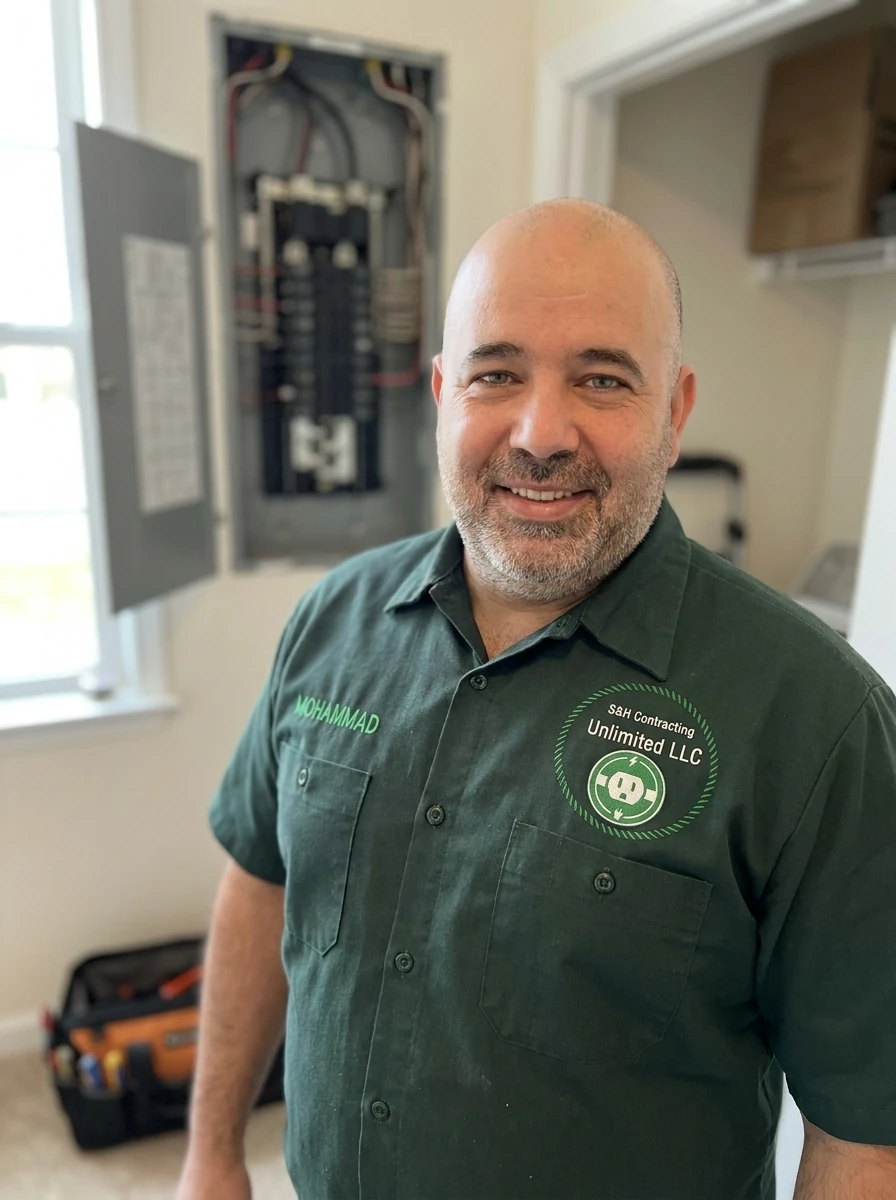
Virginia-licensed Master Electrician with 16-plus years in the trade. Mohammad works in Alexandria regularly — he knows the APEX portal, the correct Dominion residential line for meter pulls, and when BAR review applies to panel work.
Alexandria’s owner-occupancy rate is 42.1% — the majority of housing is rental. If you are a landlord or property manager, panel upgrades protect your investment, keep tenants safe, and prevent insurance friction at renewal. Mohammad works with property managers on multi-unit panel assessments, handling the building-management coordination and tenant-access scheduling that individual-unit work in Alexandria requires.
S&H Contracting Unlimited is rated 5.0 stars across 77 Google reviews. Our Woodbridge shop is approximately 18 miles from Alexandria — not the closest electrician, but the one who shows up knowing your permit office, your utility company, and your neighborhood’s wiring. Read more about our team.
Panel upgrade questions — Alexandria, VA
How much does a panel upgrade usually cost in Alexandria?
Alexandria panel upgrades tend to cost more than in newer cities because the housing stock is older (more rewiring alongside the panel), the permit process includes a 10-business-day plan review, and the Historic District adds BAR review for exterior work. The variables: current amperage, wiring condition, service-entrance state, and whether BAR applies. We do not publish a flat rate — the only accurate number comes from a diagnostic visit. Call 703-972-5571.
How much does it cost to upgrade from 100 amp to 200 amp?
The 100-to-200 upgrade is the most common project in Alexandria. The cost depends on the wiring era: a 1980s home with copper PVC wiring is a straightforward panel swap. A 1950s home with cloth-insulated wiring usually includes partial rewiring of degraded circuits. A pre-1940 Old Town home with knob-and-tube typically requires full rewire. The scope varies with each house.
Does Old Town Historic District affect electrical work?
Yes — if the work involves exterior modifications visible from the street. Conduit runs on the facade, panel relocation to an exterior wall, solar panel mounting, and EV charger mounting on front-facing walls all require Board of Architectural Review (BAR) approval on top of the building permit. This adds approximately 10 business days. Interior panel work does not trigger BAR review.
Who can upgrade my electrical panel?
Any Virginia-licensed electrician can file a permit and replace a panel. But in Alexandria specifically, you want one who knows the city’s own permit office (not Fairfax County), knows Virginia American Water (not Fairfax Water), and can navigate BAR if needed. Filing with the wrong jurisdiction delays the project.
Can I upgrade my panel without rewiring?
In 1970s-2000s Alexandria homes with copper PVC wiring (West End, Cameron Station, Potomac Yard), usually yes. In 1940s-1960s homes with cloth-insulated wiring (Beverly Hills, Seminary Hill, Del Ray), partial rewire is common. In pre-1940 homes with knob-and-tube (Old Town, Rosemont), full rewire is typically required — insurance carriers refuse to cover knob-and-tube.
Do I need a permit for a panel upgrade in Alexandria?
Yes. The permit files through the City of Alexandria Department of Code Administration via the APEX portal — NOT Fairfax County. Alexandria is an independent city. Residential plan review takes approximately 10 business days. We handle the filing and coordinate with the city inspector.
What utility company handles the meter pull in Alexandria?
Dominion Energy handles electricity — the meter pull for a panel upgrade coordinates through Dominion’s residential service line (1 to 3 business day appointment window). Do not confuse with Virginia American Water (water), AlexRenew (sewer), or Washington Gas (gas) — Alexandria has four separate utility entities, unlike the simpler Dominion-only setup in Prince William County.
Is my property in the Historic District?
Check the City of Alexandria’s interactive BAR map at alexandriava.gov or call the Department of Code Administration at 703-746-4200. The designated boundaries cover Old Town, Parker-Gray, and portions of Rosemont. If your property is inside the boundary, exterior electrical modifications visible from the street require BAR approval before the building permit can be issued.
Related electrical services
Ready to upgrade your Alexandria panel?
Free diagnostic visit. Written estimate. City of Alexandria permit, Dominion coordination, and BAR navigation handled from start to finish.
703-972-5571