EV Charger Installation in Lake Ridge, VA
Level 2 EV Charger Installation by a Master Electrician — 5 Minutes from Lake Ridge
Lake Ridge is adjacent to our Woodbridge shop. If your home can handle the load, the charger goes in and you are charging overnight. If it cannot, we find out during the load calculation — before you buy equipment you cannot use. Mohammed Salahuddin handles the panel assessment, the HOA paperwork, the Prince William County permit, and the installation.
What drives the cost of an EV charger installation in Lake Ridge
The charger itself is the simple part. What actually determines the cost is the electrical infrastructure behind it — and in Lake Ridge, three factors matter more than others.
- Panel capacity: a Level 2 charger draws 40 to 50 amps on a dedicated 240V circuit. If your Lake Ridge home has a 200A panel with open breaker slots (most 1980s-2000s builds), the panel can usually absorb the load. If you are on a 100A panel (1970s Thousand Oaks, The Point), a panel upgrade comes first.
- Circuit run distance: the length of wire from the panel to the charger location. A charger on the garage wall 10 feet from the panel costs less than one on the driveway side of the house 60 feet away. Lake Ridge’s predominantly attached-garage layout keeps runs short for most installs.
- HOA architectural review: Lake Ridge Parks and Recreation Association (LRPRA) covers nearly all residential properties. Exterior-mounted chargers typically require HOA approval before the electrical work begins. This adds a planning step — not a cost, but a timeline factor.
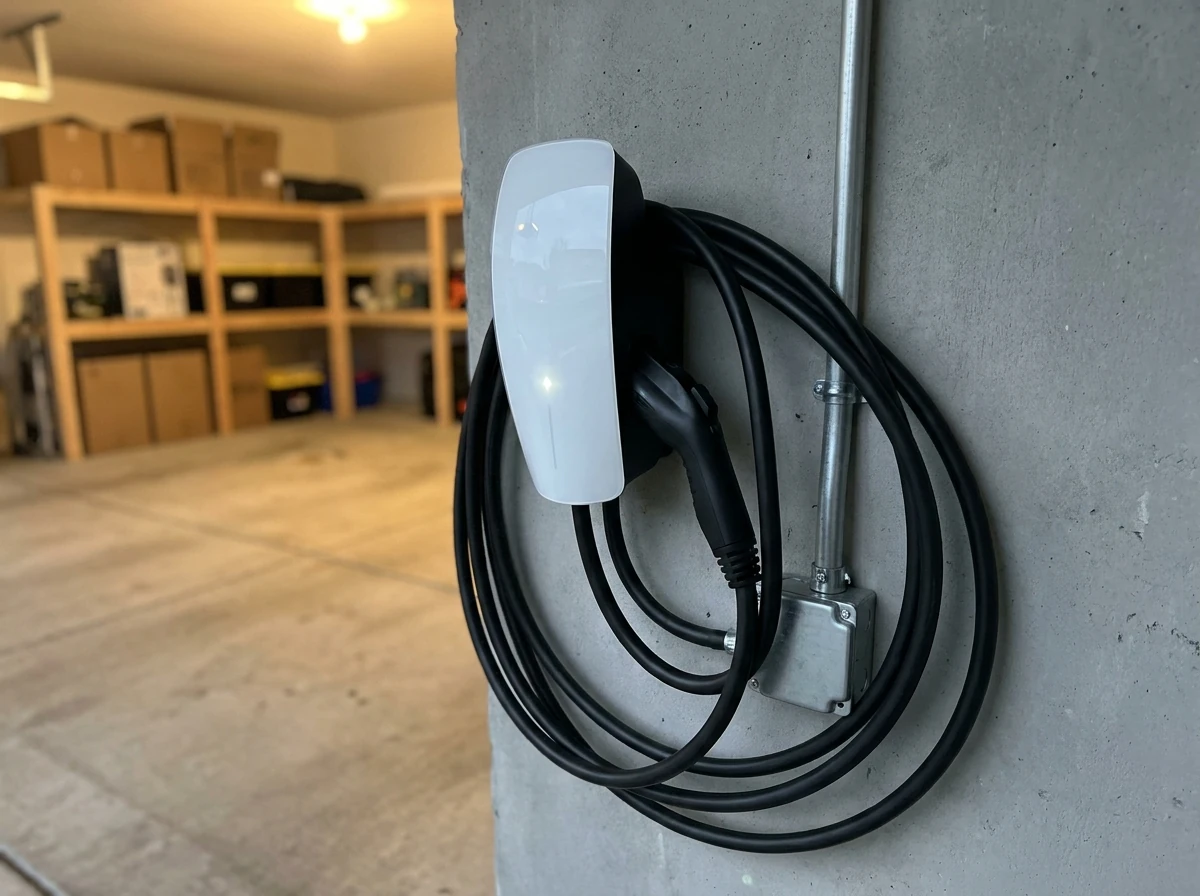
- Charger type: a Tesla Wall Connector (hardwired) vs. a NEMA 14-50 outlet (plug-in) have different wiring requirements. Hardwired draws slightly more because the connection is permanent. We install both.
Level 1 vs. Level 2 — why Level 2 is the only charger that makes overnight charging practical
Every EV comes with a Level 1 cable that plugs into a standard 120V outlet. Many Lake Ridge EV owners start there. Most switch to Level 2 within the first month.
Level 1 (120V / 12A)
- Adds approximately 4 miles of range per hour of charging
- A 40-mile daily commute (Lake Ridge to DC/Pentagon/Quantico round trip) takes roughly 10 hours to replenish
- Plugs into any standard household outlet — no installation needed
- Works as a backup, not as a primary charger for a daily commuter
Level 2 (240V / 48A)
- Adds approximately 25 to 30 miles of range per hour of charging
- A 40-mile daily commute replenishes in under 2 hours — plug in after dinner, full by bedtime
- Requires a dedicated 240V / 50A circuit from the panel and a licensed installation
- The only practical option for daily EV commuters in the Lake Ridge to DC/Pentagon corridor
The charging-rate numbers are approximate and vary by charger amperage and vehicle acceptance rate. A 48-amp Level 2 charger on a typical EV delivers approximately 25 to 30 miles per hour — enough for overnight charging of any daily commute in the Northern Virginia corridor.
Does your Lake Ridge home need a panel upgrade for an EV charger?
The answer depends on what is in your panel right now and when your home was built.
The load calculation — NEC 220.82
A Level 2 EV charger draws 48 amps continuous. Per NEC code, that requires a 60-amp breaker (48A x 1.25 continuous-use factor) and #6 copper wire (NEC 625). The question is whether your existing panel has the capacity and the open breaker slots for this additional load.
1970s homes (Thousand Oaks, The Point, Plantation Harbor): 100 to 150 amp panels. Adding a 60A EV circuit to a 100A panel that already runs HVAC, kitchen, and general loads usually exceeds safe capacity. Panel upgrade likely required. See our panel upgrade page for details.
1980s-1990s homes (Westridge, Old Bridge Estates, Cardinal Glen): 200 amp panels standard. The panel can typically absorb a 60A EV circuit if existing loads are not maxed. However, the breakers are 30 to 40 years old — we check breaker condition as part of the assessment. Usually EV-ready.
Late 1990s homes (Ridgeleigh, later Westridge sections): 200 amp panels with newer breakers. EV-ready. Main concern is AFCI nuisance-tripping from EV charger cycling on shared circuits.
We run the load calculation during the on-site assessment. If the panel can handle the charger, we install it. If it cannot, we quote the panel upgrade and the charger installation together so you see the full scope.
HOA coordination — what Lake Ridge homeowners need to know before installing an EV charger
Lake Ridge Parks and Recreation Association (LRPRA) covers the vast majority of residential properties. This is a master-planned community with near-universal HOA governance. Here is how it affects your EV charger installation.
Three scenarios for Lake Ridge EV charger installations
Exterior-mounted charger (garage face, driveway-adjacent): HOA architectural review approval is typically required BEFORE the electrical work begins. The charger is visible from the street or common area, which triggers the LRPRA review process. Submit the application, wait for approval, then we install.
Interior garage-mounted charger (wall-mount inside attached garage): may not require HOA review depending on your specific covenant language. The charger is not visible from outside. Check with LRPRA before scheduling — some covenants require notification even for interior modifications.
Solar + EV combo (panels + charger): faces the same exterior review as a standalone charger, plus solar panel architectural review. Both need HOA approval before installation begins.
EV charger brands we install
We install all major Level 2 chargers. Mohammad’s reviews specifically mention Tesla Wall Connector installations — S&H is review-validated for this exact hardware.
Tesla Wall Connector
Review-validated48A hardwired, WiFi-enabled, up to 44 miles of range per hour. Tesla-proprietary connector (NACS). The most commonly requested charger in Lake Ridge. Hardwired installation — no outlet, permanent connection. Mohammad’s Google reviews mention Tesla charger installs specifically.
ChargePoint Home Flex
Universal J177216A to 50A adjustable, hardwired or NEMA 14-50 plug-in. Works with every non-Tesla EV via J1772 connector. WiFi + app for scheduling and monitoring. The go-to universal charger for households with non-Tesla EVs or mixed fleets.
Wallbox Pulsar Plus
Universal J177240A, compact design, WiFi + Bluetooth. Popular for townhome garages where wall space is limited. NEMA 14-50 plug-in option available for portability between homes.
JuiceBox 40
Universal J177240A, WiFi-connected with energy tracking. NEMA 14-50 plug-in. Smart scheduling lets you charge during off-peak hours — relevant in Dominion territory where time-of-use rates apply.
Townhome vs. detached home — how the installation differs in Lake Ridge
Nearly half of Lake Ridge housing (44.7%) is attached — townhomes and condos. The EV charger installation is different in a townhome than in a detached single-family home.
Detached single-family home
- Panel is typically in the garage or utility room — short circuit run to the charger location
- Dedicated parking (driveway or garage) — charger placement is straightforward
- No shared-wall constraints for conduit routing
- HOA review for exterior-mounted chargers; interior garage-mount may be exempt
- Standard residential permit through Prince William County BDD
Townhome or condo
- Panel may be in an interior closet — longer circuit run to the garage or parking area
- Shared walls limit conduit routing options — surface-mount conduit may need to run through finished spaces
- Assigned parking vs. street parking — some townhome courts have no garage, requiring outdoor charger installation
- HOA review required for any visible exterior installation
- Condo association may have additional rules beyond LRPRA — verify before scheduling
The EV charger installation process — from load calculation to final inspection
Load calculation and panel assessment
We open the panel, measure your existing loads, and determine whether the panel can absorb a 50A EV circuit. If it can, we proceed. If not, we quote the panel upgrade and charger installation together.
Panel upgrade (if needed)
For 1970s Lake Ridge homes with 100A panels, the upgrade to 200A happens first. This includes Dominion coordination for the meter pull, the panel swap, and the county inspection.
HOA application (if exterior mount)
If the charger mounts on an exterior wall or garage face visible from common areas, we help you prepare the LRPRA architectural review application with charger specs and a mounting diagram.
Permit pull at Prince William County ePortal
We file the electrical permit through PWC’s Building Development Division. EV charger circuits are explicitly listed among items requiring a residential electrical permit.
Installation
We run the dedicated 240V circuit from the panel to the charger location, mount the charger (hardwired or NEMA 14-50 outlet per your choice), and connect. Most installations take half a day.
Inspection and handoff
The county inspector verifies the circuit, the breaker, and the installation. We walk you through the charger’s app setup and scheduling features. You charge overnight starting the same evening.
EV charger incentives and programs available to Lake Ridge homeowners
Several programs can offset the cost of your EV charger installation. Verify eligibility and current terms before relying on these — program details change.
Federal EV charger tax credit (IRC Section 30C / Form 8911) — expired
The Alternative Fuel Vehicle Refueling Property Credit (IRC Section 30C, claimed via IRS Form 8911) previously covered up to 30% of the cost of EV charger hardware and installation for residential properties. This credit expired on June 30, 2026. Chargers installed and placed in service before that date may still be eligible to claim on the 2026 tax return — consult a tax professional for your specific situation.
Source: IRS.gov Form 8911 — credit expired 2026-06-30; no renewal enacted as of July 2026
Prince William County EV station expansion
County plans call for expanding the public EV charging network from 14 to 35 stations, according to reporting by InsideNoVA. While this is a public infrastructure program (not residential), it signals county-level support for EV adoption and may influence future residential incentive programs. Station counts and timelines are subject to change.
Source: InsideNoVA — verify current station count and expansion timeline with Prince William County
Virginia Clean Cars Act
Virginia adopted California’s vehicle emissions standards, which require increasing percentages of zero-emission vehicle sales through 2035. This drives EV adoption rates and, indirectly, residential charger demand across the Lake Ridge to DC commuter corridor.
Source: Virginia Department of Environmental Quality — verify current regulatory status
About Mohammed Salahuddin — Master Electrician
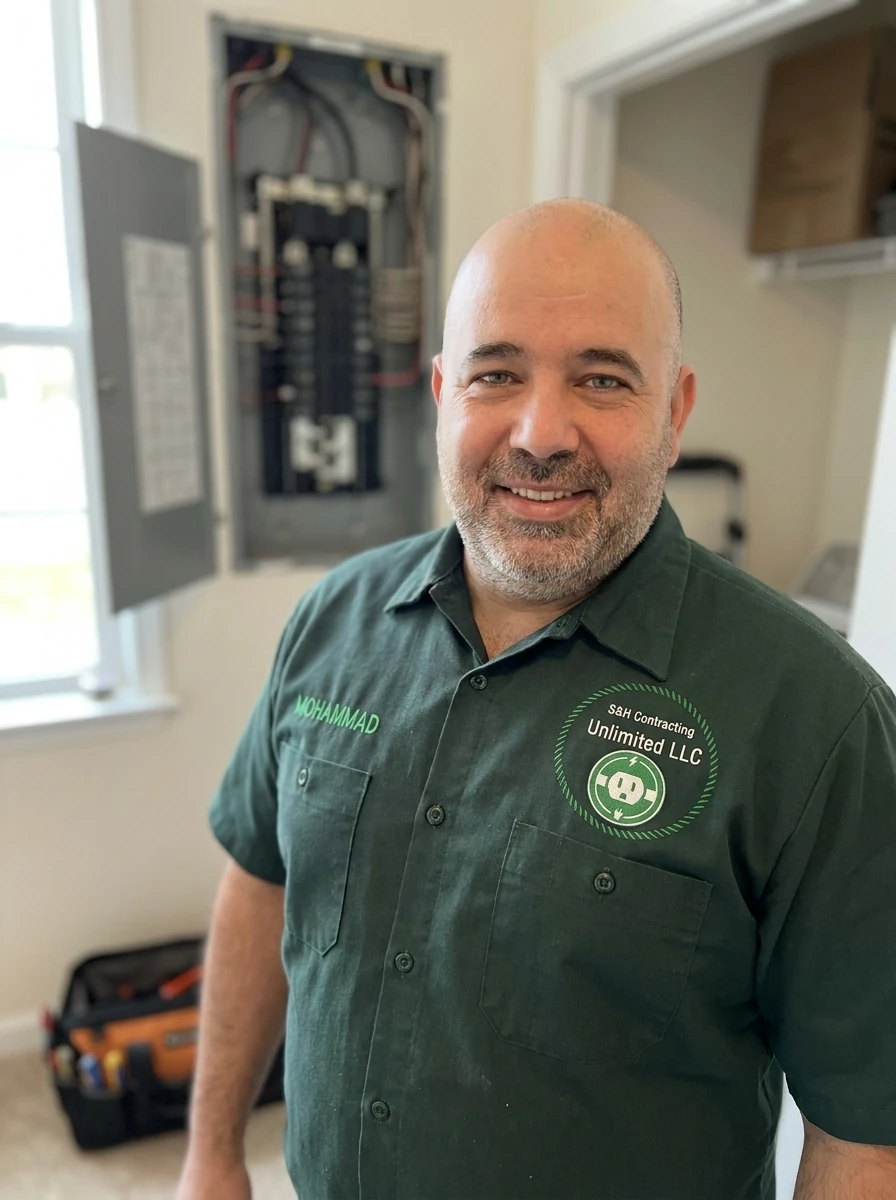
Virginia-licensed Master Electrician with 16-plus years in the trade. Mohammad’s Google reviews specifically mention Tesla Wall Connector installations — S&H is review-validated for this exact hardware, not just EV chargers in general.
On EV charger calls, Mohammad assesses the panel first. If the panel can handle the load, the charger goes in. If it cannot, he quotes the panel upgrade and installation together so you see the full scope before deciding. The load calculation is the diagnostic — it tells you whether you need a charger installation or a charger installation plus a panel upgrade.
S&H Contracting Unlimited is rated 5.0 stars across 77 Google reviews. S&H’s Woodbridge shop is 5 minutes from Lake Ridge — same-day availability is real. Read more about our team.
EV charger installation questions — Lake Ridge, VA
How much does an EV charger installation cost in Lake Ridge?
The cost depends on three main factors: whether your panel needs an upgrade (1970s 100A panels usually do; 1980s+ 200A panels usually do not), the length of the circuit run from the panel to the charger, and whether you choose a hardwired or plug-in charger. We do not publish a flat rate because the scope varies with each home. The on-site assessment is free — call 703-972-5571.
Do I need a panel upgrade for an EV charger?
If your Lake Ridge home has a 200A panel (most homes built after 1980), you probably do not need an upgrade — the panel can typically absorb a 50A EV circuit if existing loads are not maxed. If you are on a 100A panel (1970s-era Thousand Oaks, The Point, Plantation Harbor), a panel upgrade to 200A is usually required first. We run a load calculation during the assessment to give you a definitive answer.
Does Lake Ridge HOA allow EV chargers?
Yes, but exterior-mounted chargers typically require LRPRA architectural review approval before installation begins. Interior garage-mounted chargers may not require review depending on your specific covenants. Solar+EV combinations face the same exterior review. Check with LRPRA and we will factor the approval timeline into the project schedule.
Level 1 vs Level 2 — which do I need?
Level 2. A Level 1 charger (standard 120V outlet) adds approximately 4 miles of range per hour — impractical for a daily commuter in the Lake Ridge to DC corridor. A Level 2 charger (240V / 48A) adds approximately 25 to 30 miles per hour, replenishing a 40-mile commute in under 2 hours. Level 2 is the only charger that makes overnight charging practical.
How long does an EV charger installation take?
The charger installation itself takes half a day. If a panel upgrade is needed (100A to 200A), add a day for the panel work. The total timeline also includes the permit (filed via PWC ePortal) and HOA review if the charger mounts externally. We manage the permit and can help with the HOA application.
Do I need a permit for an EV charger in Prince William County?
Yes. Prince William County explicitly lists EV charging station circuits and outlets among items requiring a residential electrical permit. We file through the Building Development Division via ePortal at pwcva.gov. The permit and inspection protect your homeowner’s insurance and property record.
Can you install a Tesla Wall Connector?
Yes. Mohammad’s Google reviews specifically mention Tesla Wall Connector installations. The Tesla Wall Connector is a 48A hardwired unit — it requires a dedicated 60A breaker and #6 copper wire run from the panel. We install the circuit, mount the charger, and connect. Most Tesla installs in Lake Ridge are straightforward half-day jobs.
What EV incentives are available for Lake Ridge homeowners?
The federal EV charger tax credit (IRC Section 30C, Form 8911) expired on June 30, 2026. Chargers installed before that date may still be claimable on the 2026 return — consult a tax professional. Prince William County is expanding its public EV network. Virginia’s Clean Cars Act is driving EV adoption statewide.
Related electrical services
Ready to charge at home in Lake Ridge?
Free panel assessment. HOA guidance. Prince William County permit handled. Level 2 charger installed and charging overnight.
703-972-5571