
24/7 Emergency Electrician in Alexandria, VA
Alexandria’s Oldest Homes, Newest Emergencies
When cloth-insulated wiring from a 1920s Old Town rowhouse starts failing under modern loads, the smell of burning behind plaster walls is not hypothetical. Mohammed Salahuddin is a Virginia-licensed Master Electrician who responds to Alexandria electrical emergencies within 45 minutes. He stabilizes the immediate danger, then explains what actually happened before quoting the permanent fix.
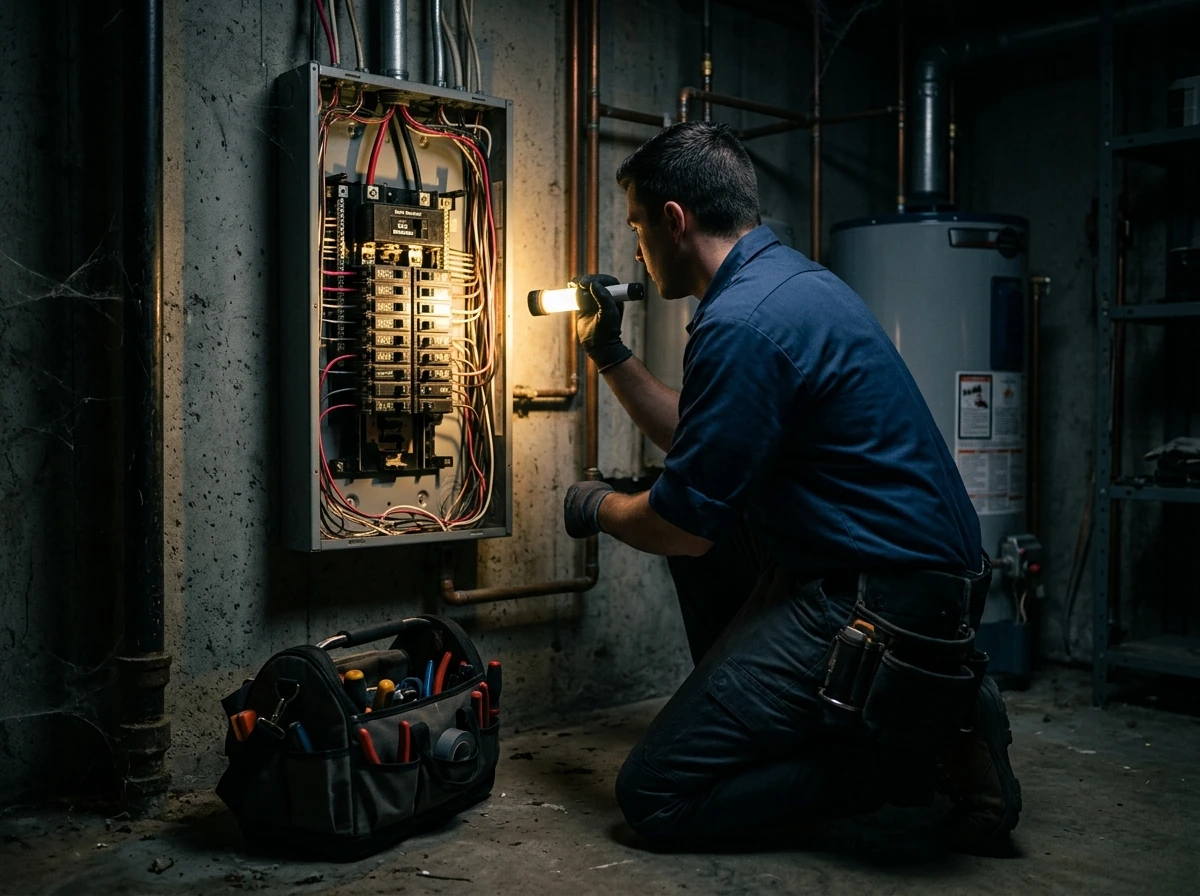
Shut off the main breaker if any of these are happening right now
- Burning smell coming from behind a wall, outlet, or the electrical panel
- Sparking or arcing at an outlet or switch — visible flash or popping sound
- Panel cover hot to the touch or showing scorch marks
- Lights flickering and dimming across multiple rooms simultaneously
- Shock when touching a switch, outlet, or appliance
In Alexandria’s pre-1940 homes across Old Town and Del Ray, these symptoms often trace to degraded cloth-insulated wiring that is cracking under modern electrical loads. The insulation breaks down, conductors contact framing or each other, and a short develops behind plaster walls where you cannot see it. Turn off the main breaker if you can reach it safely, and call us.
Call 703-972-5571 nowThe five most common electrical emergencies in Alexandria homes
Each type traces to a specific housing era and neighborhood pattern. Knowing which one you are dealing with helps us triage the call.
Cloth-insulated wiring failure
Old Town / Del Ray, pre-1940
Degraded insulation cracking under modern loads. You smell burning behind plaster walls or notice a hot outlet. The short is developing at a point you cannot see. This is the most dangerous emergency type in Alexandria because the wiring is concealed behind original plaster and lath. Often needs rewire plus panel upgrade.
FPE/Zinsco panel failure
Seminary Hill, 1950s-1960s
Federal Pacific Stab-Lok breakers that do not trip during overload. The breaker fails to protect the circuit, the wire overheats, and the panel itself becomes the ignition source. Documented failure-to-trip rates in tested units. If your Seminary Hill home has a Federal Pacific panel, replacement is the safety decision.
Overloaded circuits tripping under modern loads
Rosemont, 1920s-1940s
Original 60 to 100 amp panel with modern AC, kitchen appliances, and home-office equipment on circuits designed for lamps and a radio. The breaker trips when the AC compressor starts because it is sharing a circuit with the kitchen. The tripping is the protection working — but it means the panel cannot handle what you are asking it to do. Capacity upgrade is the fix.
GFCI-absent bathroom fault
West End condos, pre-1996
No ground-fault circuit interrupter protection at bathroom receptacles. The NEC has required GFCI in bathrooms since 1975, but retro compliance varies in Alexandria’s condo conversions. A fault near water without GFCI protection is a shock hazard. Immediate safety: do not use the outlet. Permanent fix: GFCI retrofit as part of a panel assessment.
Aluminum wiring connector failure
Park Fairfax area, 1960s-early 1970s
Aluminum-to-copper junctions at receptacles and switches oxidize over time. The oxidation increases resistance, the connection heats, and you see a warm outlet or discolored cover plate. Homes built during the 1965 to 1972 era may have aluminum branch wiring. This is a fire risk that progresses slowly until it does not — the connection fails under load.
How S&H’s 45-minute emergency response works for Alexandria
S&H’s Woodbridge headquarters is approximately 18 miles from Alexandria — inside the 45-minute truck radius for emergency response. The maintenance team dispatch model means the closest available technician responds, not a scheduler who quotes you a window.
Response logistics
- Woodbridge HQ → Old Town Alexandria ~20-30 min
- Woodbridge HQ → Seminary Hill ~25-35 min
- Woodbridge HQ → Del Ray / Rosemont ~20-30 min
- Woodbridge HQ → West End ~25-35 min
Honest about capacity: if the entire team is already dispatched on active calls, we give you a real ETA — not a marketing claim. Most nights and weekends, a technician is available within the 45-minute window. During major storms or heat waves when call volume spikes, we tell you exactly where you are in the queue and whether the situation warrants calling 911 in the meantime.
Mohammed Salahuddin built the emergency response arm of S&H on one principle: the midnight call gets the same diagnostic attention as the scheduled Tuesday visit. The signature Google review — the HVAC pull-out disconnect at midnight — is not an anomaly, it is the operating standard.
Emergency repairs in Alexandria’s Historic District: what is different
Alexandria is an independent city with its own code enforcement. Within the Old Town, Parker-Gray, and Del Ray historic districts, the Board of Architectural Review (BAR) adds a regulatory layer on top of standard building permits. For emergency electrical work, here is what that means in practice.
After the emergency: what needs permanent repair vs. what the temporary fix covers
Every emergency call has two phases. The first is making the situation safe right now. The second is the permanent fix that prevents it from happening again. Here is how they differ.
Temporary safe state (tonight)
- Affected circuit isolated at the breaker — power stays off to that circuit only
- Damaged outlet or switch replaced with a safe temporary connection
- Loose panel connections tightened and thermally verified
- Overloaded circuit redistributed to reduce load below capacity
- GFCI installed at the immediate fault location
- You have power to the rest of the house — the emergency is contained
Permanent fix (scheduled follow-up)
- FPE/Zinsco panel replaced with a modern panel — full panel upgrade
- Cloth-insulated wiring replaced in the affected zone or throughout the house
- Aluminum wiring connections remediated with approved connectors
- Service entrance upgraded from 100A to 200A if the root cause is capacity
- GFCI retrofitted at all code-required locations, not just the fault point
- Full load calculation and circuit mapping to prevent recurrence
The diagnostic-first approach means we tell you what each phase costs separately. The temporary fix happens the night of the call. The permanent fix gets quoted, permitted, and scheduled — you are not pressured into a major decision at 2 AM.
When to call 911 vs. when to call an electrician
Not every electrical problem is the same kind of emergency. Here is the decision tree for Alexandria.
Call 911 immediately
Fire, smoke, or active electrical fire. Visible flames at an outlet, panel, or inside a wall. Smoke pouring from a fixture or switch. Do not touch the panel. Do not try to disconnect power. Get everyone out, call 911, and let the fire department handle the disconnect at the pole or transformer.
Alexandria Fire Department: 911. Dominion Energy emergency line for pole-side disconnect: 1-866-366-4357.
Call Dominion Energy
Power out to the whole house or the whole street. If your neighbors also lost power, it is a utility-side issue — a downed line, a blown transformer, or a grid problem. Dominion handles everything from the pole to your meter. Their outage line: 1-866-366-4357.
If only your house is out and the neighbors have power, the problem is on your side of the meter — that is an electrician call, not a utility call.
Call S&H Contracting — 703-972-5571
Sparking outlet (no fire), burning smell (no visible smoke), hot panel, tripping main breaker, shock from a switch or appliance, partial power loss in one area of the house. These are active electrical failures that need a licensed electrician, not the fire department. Turn off the affected breaker if you can identify it. If you cannot, turn off the main.
We respond within 45 minutes to Alexandria. The technician stabilizes the hazard and explains what happened before any permanent-repair quote.
What drives emergency electrician rates
Emergency calls cost more than scheduled work. Here is why and what moves the number.
- After-hours premium: emergency response outside of normal business hours carries a premium because a technician is dispatched from rest to your location at night, on weekends, or on holidays. This is standard across the industry — the premium covers the response commitment, not the complexity of the work.
- Diagnostic fee: the emergency visit includes diagnosis. The technician opens the panel, traces the fault, identifies the cause, and explains what happened. This diagnostic work is the same whether the fix is a breaker replacement or a full panel swap.
- Temporary stabilization vs. permanent repair: the emergency visit stabilizes the immediate danger. The permanent fix — if it involves a panel upgrade, rewiring, or code-triggered work — is quoted separately and scheduled at regular rates. You are not paying emergency rates for a Tuesday-morning panel installation.
- Historic-district complications: in Alexandria’s Old Town and Del Ray, emergency repairs in pre-1940 homes sometimes involve plaster-and-lath walls, knob-and-tube remnants, or cloth-insulated wiring that takes longer to trace and isolate safely.
About Mohammed Salahuddin — Master Electrician
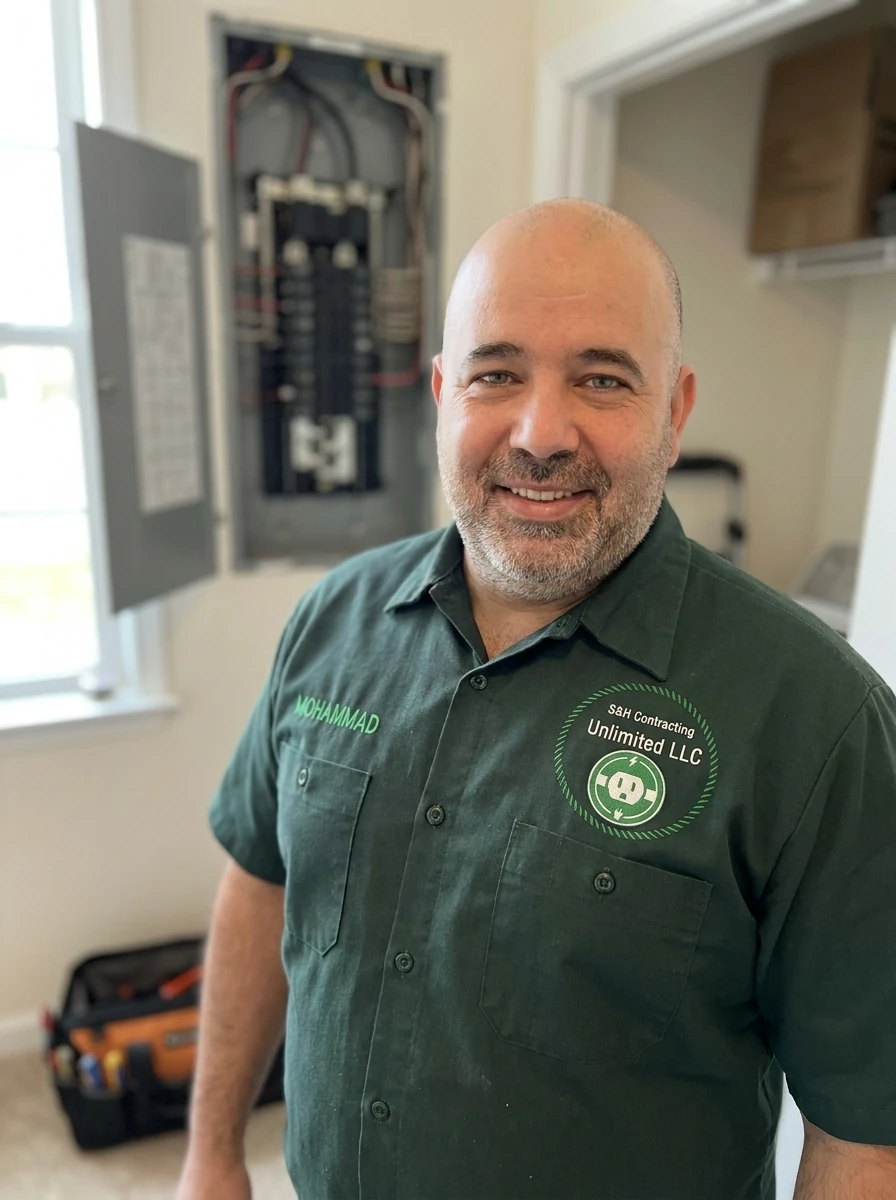
Mohammed Salahuddin holds a Virginia Master Electrician license — the highest tier the state issues. Sixteen-plus years in the trade, covering residential and commercial emergency electrical work across Northern Virginia. He runs a fully insured maintenance team out of Woodbridge, which puts Alexandria approximately 18 miles and 20 to 30 minutes away — inside the 45-minute emergency response radius.
The signature S&H emergency story comes from the Google reviews: a midnight call for an HVAC pull-out disconnect where Mohammad was the only electrician who answered, came out the same night, provided a temporary fix, and scheduled the permanent repair for the next business day. That review — “the only one/company that came in and gave me a temporary fix same day” — is the operating standard, not the exception.
S&H Contracting Unlimited is rated 5.0 stars across 77 Google reviews (re-verify count at publish time). Read more about our team.
Alexandria neighborhoods we serve for emergencies
- Old Town — pre-1800s to 1940s; cloth-insulated wiring, knob-and-tube remnants, BAR historic district
- Del Ray — 1920s-1940s bungalows and rowhouses; original wiring under renovation loads
- Rosemont — 1920s-1940s; 60-100A panels under modern load stress
- Seminary Hill — 1950s-1960s; FPE/Zinsco panel concentration
- Park Fairfax — 1940s-1960s garden apartments; possible aluminum branch wiring (1965-1972 era)
- West End — mixed era condos and townhomes; GFCI compliance gaps in pre-1996 builds
- Eisenhower Valley — newer development; modern panels but commercial-to-residential conversion issues
- Landmark / Van Dorn — 1970s-1980s apartments and condos; aging breakers
We also serve Woodbridge, Manassas, Lake Ridge, Dale City, and the broader Northern Virginia region for emergency calls.
Related electrical services
Many emergency calls lead to scheduled follow-up work. If the root cause is the panel, the wiring, or a load issue, we handle the permanent fix too.
Emergency electrician questions — Alexandria, VA
What is an emergency electrician?
An emergency electrician responds to electrical failures that pose an immediate safety risk — sparking outlets, burning smells from wiring, hot panels, breakers that will not trip, or complete loss of power on your side of the meter. The distinction from scheduled electrical work is urgency: the problem cannot safely wait until Monday. We respond 24/7 including nights, weekends, and holidays.
How much do electricians charge per hour in Virginia?
Emergency rates include an after-hours premium on top of the standard hourly rate. The premium covers the on-call commitment and immediate dispatch. At S&H, the emergency visit includes a full diagnostic — the technician identifies the cause and explains it before any repair quote. The permanent fix, if it is a separate job like a panel upgrade or rewire, is quoted at regular rates and scheduled during business hours. You are not paying emergency rates for Tuesday-morning work.
Who do you call for electrical problems?
It depends on the problem. If you see fire or smoke: call 911. If the whole street lost power: call Dominion Energy at 1-866-366-4357. If only your house is affected — sparking, burning smell, hot panel, tripping breaker, shock — call a licensed electrician. S&H responds to Alexandria emergency calls at 703-972-5571, 24/7.
What should I do during a power outage in Alexandria?
Check whether your neighbors also lost power. If they did, it is a Dominion Energy grid issue — report it at 1-866-366-4357 and wait. If only your house is out, check the main breaker. If it tripped, try resetting it once. If it trips again immediately, do not keep resetting — the breaker is protecting you from a fault. Call an electrician. Alexandria is served by Dominion Energy; the city does not operate its own electric utility.
Does Alexandria have its own electrical code enforcement?
Yes. Alexandria is an independent city — not part of Fairfax County or Arlington County. The City of Alexandria Department of Code Administration handles all electrical permits and inspections. Emergency repairs that require follow-up permits go through the city’s own office, not the county. In the historic districts (Old Town, Parker-Gray), exterior electrical modifications may also require Board of Architectural Review coordination.
Should I turn off the breaker if I smell burning?
Yes, if you can reach the panel safely. Turn off the main breaker — not just the individual circuit breaker, because you may not know which circuit the burning smell is coming from. If you see smoke or flames, do not approach the panel — get everyone out and call 911. If you smell burning with no visible smoke, turn off the main and call an electrician. The burning smell means active electrical failure is happening inside a wall, at an outlet, or in the panel.
How fast can an electrician get to Alexandria?
S&H’s Woodbridge headquarters is approximately 18 miles from Alexandria. In normal traffic, response time is 20 to 30 minutes to most Alexandria neighborhoods. During peak rush hour on I-95 or Route 1, it may extend to 35 to 45 minutes. We give you a real ETA when you call — not a window, an actual estimated arrival based on where the nearest available technician is at that moment.
Electrical emergency in Alexandria?
24/7 response. Master Electrician on every call. Diagnostic before any repair quote. Inside the 45-minute response radius.
703-972-5571