
24/7 Emergency Electrician in Springfield, VA
Master Electrician. 24/7 Emergency Dispatch.
Mohammed Salahuddin is a Virginia-licensed Master Electrician with 16+ years in the trade. We dispatch 24/7 — overnight, Sundays, holidays — with a typical 20–30 minute response inside the Springfield service area. Call comes in, technician rolls, diagnosis before any work starts.
What counts as an electrical emergency
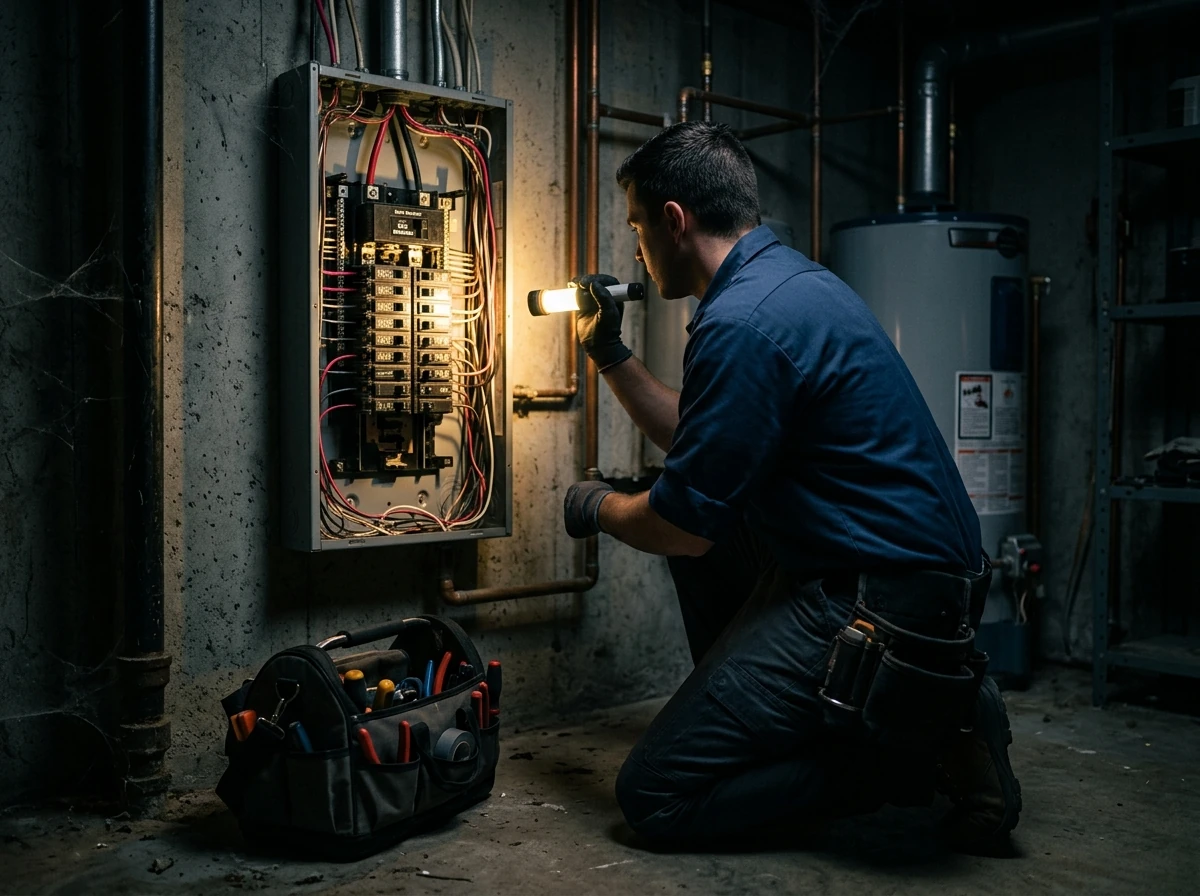
An electrical emergency is any situation that poses an immediate risk of fire, shock, or loss of essential power in your home. Sparks from an outlet, a burning smell behind a wall, a breaker panel that’s hot to the touch, exposed wiring, water pooling near electrical equipment, or a partial power outage when your neighbors still have power — these are all active safety risks. If you see fire, smoke, or active sparking, call 911 first. Then call us. We handle the electrical side once the scene is safe.
Not every electrical issue is an emergency. A single dead outlet, lights that dim briefly when the AC kicks on, or an intermittent flicker in one room — those are worth a service call, but they can usually wait for a scheduled appointment. An emergency is when there’s an active safety risk to people in the house or when you’ve lost power entirely and the utility confirms the outage isn’t on their end. If you’re not sure which side your situation falls on, call 703-972-5571 and describe what you see — we’ll tell you straight whether it needs a truck now or a Tuesday appointment.
Mohammed Salahuddin is a Virginia-licensed Master Electrician — the highest electrician tier the state issues — with 16+ years diagnosing residential electrical failures across Northern Virginia, DC, and Maryland. Mohammed Salahuddin runs a maintenance team, which is what makes the 24/7 dispatch and 20–30 minute response time inside the Springfield service area a real operational number, not a marketing claim. Call comes in. Technician rolls. Temporary safe state first, then targeted diagnosis, then the permanent fix — scheduled or completed the same visit.
Why Springfield homeowners call us for emergency electrical service
Springfield, VA sits at the intersection of three interstates — I-95, I-395, and I-495 — in southern Fairfax County. The community is anchored by the Springfield Town Center, the Franconia-Springfield Metro station, and some of the region’s most connected highway infrastructure. Springfield is 15 miles from downtown DC and within 15 minutes of Burke, Lorton, Annandale, and Alexandria.
1950s-1960s ramblers, split-levels & Cape Cods
North Springfield, Ravensworth, Kings Park, Springfield ForestSpringfield’s first wave of suburban homes arrived in the 1950s when developer Edward Carr began building ramblers along the newly opened Shirley Highway (now I-95/I-395). These homes were built with 60-100 amp panels and circuits sized for a 1950s appliance load — refrigerator, toaster, a window AC unit if you were lucky. Plumbing is original galvanized steel running to copper at the fixtures. Insulation is thin (R-13 walls at best, often less). By the 1960s, the typical Springfield home had grown to 3-4 bedrooms and 1,200-2,200 square feet, but the electrical infrastructure stayed modest. Fast-forward to 2026: induction range, central AC, two refrigerators, a tankless water heater, and an EV charger in the garage. Modern load overwhelms circuits the original builder never planned for.
Symptoms: 60-100A panels with circuits sized for 1950s-1960s loads; Federal Pacific Stab-Lok or Zinsco panels documented as fire-risk brands; fuse boxes instead of breakers in some units; frequent breaker trips when modern appliances run simultaneously; insurance carriers flagging FPE/Zinsco at renewal; overhead service drops from utility poles.
1970s-1980s colonials, split-levels & townhomes
West Springfield, Saratoga, Newington, Orange Hunt, Rolling ValleySpringfield’s second major building wave brought colonials, larger split-levels, and early townhome communities. These homes typically have 100-200 amp panels — better than the 1950s stock, but a subset from the mid-1970s may have aluminum branch wiring (NEC banned aluminum branch circuits in 1972 but installation continued for several years after). GFCI coverage is spotty — the 1996 NEC made GFCIs mandatory at every kitchen counter receptacle, but pre-1996 homes usually have one or two if any. Central AC is standard, plumbing is mostly copper with early PEX appearing in the late 1980s. Insulation improves to R-19 walls.
Symptoms: 100-200A panels original at construction; EV charger or whole-house renovation triggers the upgrade to modern 200A with AFCI/GFCI breakers; some aluminum branch wiring in mid-1970s homes; GFCI coverage spotty in pre-1996 builds.
2000s-2020s townhomes, condos & infill
Franconia-area near Metro, Springfield Town Center-adjacent, Kingstowne-edgeNewer construction in Springfield clusters around transit and the Town Center redevelopment. These homes have 200-amp service, AFCI breakers (arc-fault circuit interrupters required by NEC 2008 and tightened in subsequent code cycles), and PEX plumbing. But newer homes aren’t exempt from issues. AFCI breakers are sensitive by design and trip on noisy loads. Smart-home wiring done by previous owners can leave neutral wires bonded incorrectly. High-efficiency heat pumps and tankless water heaters pull continuous high loads the original branch circuits sometimes can’t sustain. Townhome HOAs add an approval layer for visible-from-street work like EV charger installations.
Symptoms: 200A panels standard; upgrades here are usually about adding capacity for EV chargers, hot tubs, or home additions, not safety replacement; AFCI breaker nuisance-tripping on noisy loads; HOA coordination may be needed for visible exterior panel work in planned communities.
Most of the emergency calls we get from Springfield trace back to the same few causes — aging panels in homes built before 1990, overloaded circuits from modern appliance loads, and storm damage to service-entrance hardware. If your home fits that profile, you already know our number.
Electrical emergencies we handle every week in Springfield
Here are the calls Mohammed gets most often from Springfield homeowners. If your situation matches one of these, call now — don’t wait.
Sparking outlet or arcing
Visible sparks, burn marks around the outlet plate, or an electrical arcing sound means something is failing inside the box — a loose connection, damaged wiring, or a worn outlet. Kill the breaker for that circuit if you can identify it safely. Don’t plug anything back in. Call us.
Burning smell from an outlet, switch, or panel
An acrid electrical burning smell with no visible fire source usually means a connection is overheating — inside a junction box, behind a switch plate, or at the breaker panel bus bar. This is the leading cause of residential electrical fires. Stop using the circuit immediately. If the smell is at the panel, call us today — we treat this as urgent.
Power out in part of the house — not a utility outage
If your neighbors still have power and part of your house is dark, the cause is inside your system — a tripped main, a failed breaker, a loose service-entrance connection, or a blown neutral. We diagnose which level the failure is at and fix it. If it’s a utility-side issue (meter base, weatherhead), we coordinate with Dominion Energy so you’re not bouncing between calls.
Breaker keeps tripping or won’t reset
A breaker that trips once is doing its job. A breaker that trips every time you reset it, or that’s hot to the touch, points to an overloaded circuit, a short downstream, or a worn breaker that’s no longer holding. Don’t tape the breaker or hold it in the ON position — that defeats the safety mechanism. We trace the circuit and find the cause.
Buzzing or humming from the panel
A low hum from a transformer is normal. A loud buzz or crackle from inside the breaker panel is not — it usually means a loose breaker connection, a failing bus bar, or arcing inside the panel. Don’t open the panel cover yourself. Call us and we’ll assess it same-day.
Hot outlet, plug, or switch plate
An outlet or switch that’s warm to the touch is a warning sign — overloaded circuit, loose wiring, or degraded contact inside the device. Unplug everything from that outlet and stop using the switch. If the heat is significant (too hot to hold your hand on), kill the breaker and call us immediately.
Electrical shock from an appliance or fixture
A tingling shock when you touch a tap, appliance, or light fixture means there’s a ground fault somewhere in the system — current is traveling a path it shouldn’t. This is a safety risk, especially in wet areas (kitchen, bathroom, laundry). We test for ground faults, identify the source, and repair the wiring.
Storm damage — fallen wires or damaged service mast
After a storm, if you see a downed line on your property, a broken service mast, or damage to the weatherhead where the utility connects to your house — stay away from the wires, call 911 if lines are on the ground, then call us. We coordinate with the utility for the service-side work and handle the house-side repairs.
Water near outlets or the electrical panel
A flood, burst pipe, or roof leak near electrical outlets or the breaker panel is a combination emergency. If you can safely reach the main breaker, kill it. Never touch wet electrical equipment. We come out, assess the water/electrical intersection, and make it safe before any restoration work begins.
What happens when you call — our emergency response process
When you call 703-972-5571 with an electrical emergency, here’s what happens.
Phone triage — 5 minutes
We pick up. You describe the symptoms — what you see, smell, hear. We ask about your panel location, whether you’ve been able to kill the breaker, and whether anyone was shocked or injured. If there’s an active fire or someone is injured, we tell you to call 911 first — we’re electricians, not first responders.
Dispatch — typically within 20–30 minutes
Mohammed runs a maintenance team, so there’s almost always a truck within the response radius. We give you a real ETA on the phone, not a window. If the team is already dispatched and we can’t hit that window, we say so and give you the honest timeline.
On-site safety check
First priority is making the scene safe — kill the right breakers, isolate the problem circuit, confirm no one is at risk. We don’t start diagnosing until the immediate danger is resolved.
Targeted diagnosis
We find the root cause, not just the symptom. A tripping breaker might be the breaker itself, a short downstream, a load-balance issue, or a failing connection at the bus bar. We test until we know which one, and we explain what we found in plain English.
Plain-language quote before any work
You get a written estimate on-site before we start the repair. Emergency rates vary by time-of-day — after-hours, Sunday, and holiday dispatch may include a surcharge. We name the surcharge before we dispatch, not after.
Repair — most emergencies resolved in one visit
Our trucks carry common parts — breakers, outlets, wire, connectors, disconnect hardware. Most residential emergencies get resolved the same visit. If the repair requires parts we don’t carry or a permit for larger work, we do the temporary safe-state fix and schedule the permanent repair.
Walk-through and prevention advice
Before we leave, we explain what failed and why. If the emergency points to a larger issue — an aging panel, undersized service, Federal Pacific breakers — we name it so you can plan the fix on your schedule, not ours.
How emergency estimates work
Emergency electrical rates vary by time of day and the scope of the repair — a midnight breaker swap costs differently than a Tuesday-afternoon outlet replacement. We give you a written estimate on-site before any work starts, and if the dispatch is after-hours, Sunday, or a holiday, we name the emergency surcharge on the phone before we roll — not after we arrive.
- Emergency electrical pricing varies by time of day and the work required. We give you the exact number before any work starts — no surprises, no fine print.
- Standard rates during business hours. After-hours dispatch (overnight, Sunday, holidays) may include an emergency surcharge that we name on the phone before we dispatch — not after we arrive.
- The estimate covers the diagnosis, the repair labor, and any parts from the truck. If the repair requires follow-up work (panel upgrade, rewiring), that gets a separate estimate on a separate visit.
- Diagnostic-only visits are available if you want the diagnosis without committing to same-visit repair. We tell you what’s wrong and what it costs to fix — you decide.
We don’t post fixed prices for emergency work because every emergency is different — time of day, scope of failure, parts needed. The on-site estimate is the only honest number.
About Mohammed Salahuddin, Licensed Electrical Contractor
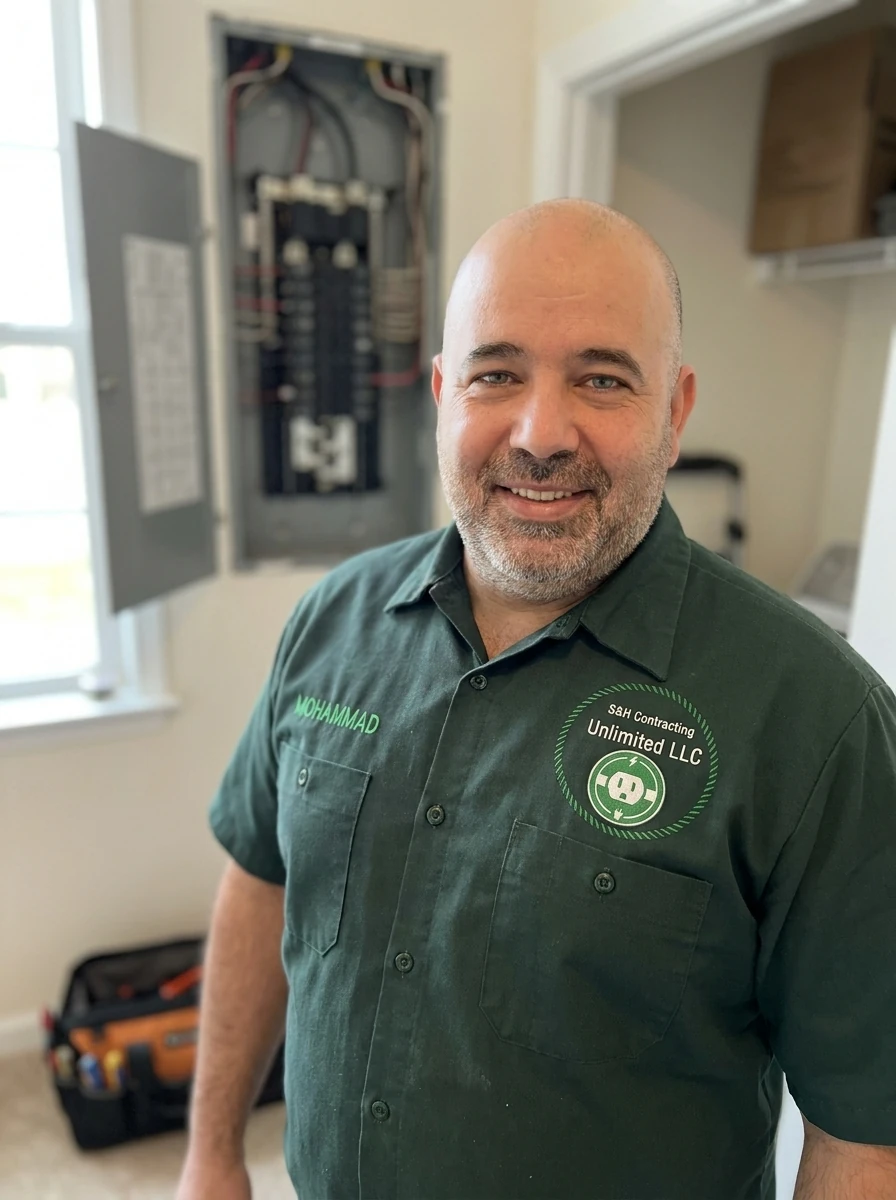
Mohammed Salahuddin is a Master Electrician licensed in Virginia — the highest electrician tier the state issues, requiring several years of journeyman work, a passed state exam, and a clean record. Over 16+ years in the trade, Mohammed Salahuddin has built a licensed and insured residential and commercial electrical practice serving Northern Virginia, Washington DC, Maryland, and Pennsylvania. He runs a maintenance team, which is what makes the 24/7 emergency dispatch and 20–30 minute response time an operational reality, not a phone-room promise.
Mohammed Salahuddin leads the diagnostic on most residential emergency calls personally. The approach is diagnostic-first, fix-second — he reads the panel, runs the tests, and explains what’s happening in plain English before any work starts. Half the time a homeowner calls expecting a full panel replacement, the actual cause is a single worn breaker, a load-balance issue, or a downstream short. The walk-through costs nothing. The misdiagnosis costs everything.
S&H Contracting Unlimited holds a 5.0-star average across 69 customer reviews. Real reviews from Northern Virginia, DC, and Maryland customers across residential and commercial jobs. 5.0-star average across 69 verified Google reviews.
Springfield neighborhoods we serve
We cover all of Springfield, VA, including:
- North Springfield — the 1950s subdivision north of Old Keene Mill Road
- West Springfield — the residential sector west of Rolling Road
- Kings Park — the 1960s-1970s neighborhood near Kings Park Elementary
- Saratoga — garden-style townhomes and condos near Fairfax County Parkway
- Franconia — condos and townhomes near the Blue Line Metro
- Newington — the southern Springfield area near Fort Belvoir
- Springfield Forest — the established neighborhood along Backlick Road
- Ravensworth — the postwar neighborhood north of Braddock Road
Outside Springfield, we serve Burke, Lorton, Alexandria, Annandale, Franconia, and the rest of Fairfax County. We also cover Woodbridge, Manassas, and the broader Northern Virginia region.
Related electrical services in Springfield
Emergency visits often uncover issues worth fixing on a planned schedule — an aging panel, undersized service, or a circuit layout that can’t keep up with modern loads. These are the services Springfield homeowners book most after an emergency call.
Frequently asked questions
What is considered an electrical emergency?
An electrical emergency is any situation that poses an immediate risk of fire, shock, or injury. Sparking outlets, a burning smell from behind a wall or at the panel, a breaker panel that’s hot to the touch, exposed or damaged wiring, water pooling near electrical equipment, and partial or total power loss when the utility confirms no outage on their end — all of these qualify. If you see active fire, smoke, or sparks, call 911 first, then call us at 703-972-5571. We handle the electrical diagnosis and repair once the scene is safe.
How quickly can you arrive for an emergency in Springfield, VA?
Typically within 20–30 minutes inside the Springfield service area. That number is real because Mohammed Salahuddin runs a maintenance team — there’s almost always a truck within the response radius, day or night. We dispatch 24/7, including overnight, Sundays, and holidays. If the team is already out on another emergency and we can’t hit that window, we tell you on the phone and give you an honest ETA — not a vague arrival window. Call 703-972-5571 and we’ll confirm the timeline before we roll.
What should I do before the electrician arrives?
Six things, in this order: 1. If there’s active fire, smoke, or someone was shocked and injured, call 911 first. 2. Kill the main breaker if you can reach it safely — this de-energizes the house. 3. Do not touch any wet electrical equipment, ever. 4. If there’s water near outlets or the panel, stay clear and wait for us. 5. Keep children and pets away from the affected area. 6. Do not re-energize circuits that tripped — if a breaker tripped, it tripped for a reason. Then call 703-972-5571 and describe what you see.
When should I call 911 instead of an electrician?
Call 911 first when there’s active fire, visible smoke, sustained sparking, a downed power line on your property, or someone who has been shocked and is injured or unresponsive. These are life-safety situations — firefighters and EMS come first. Once the scene is safe, call us at 703-972-5571. We handle the electrical diagnosis and repair after the immediate danger is resolved. If you’re unsure whether your situation is a 911 call or an electrician call, err on the side of 911. We’d rather show up to a scene the fire department already cleared than have you wait on a situation that needed first responders.
How much does an emergency electrician cost in Springfield, VA?
We don’t post fixed prices for emergency work because every emergency is different — time of day, scope of failure, and parts needed all factor in. What we do: you get a written estimate on-site before any work starts, so you know the exact number and approve it before we pick up a tool. If the call is after-hours, on a Sunday, or on a holiday, there may be an emergency surcharge — and we name that surcharge on the phone before we dispatch, not after we arrive. No surprise charges. The on-site estimate is the only honest number for emergency electrical work.
Are you really available 24/7 — including Sundays and holidays?
Yes. 24/7 means 24/7 — overnight, Sundays, Thanksgiving, New Year’s, no exceptions. This isn’t a marketing line. Mohammed Salahuddin runs a maintenance team with trucks in the Northern Virginia service area, so there’s almost always someone within the response radius regardless of the day or hour. The typical response inside the Springfield area is 20–30 minutes. If you call at 2 AM on Christmas morning with a melted HVAC pull-out disconnect, we answer the phone, triage the symptoms, and dispatch. The maintenance team is what makes the 24/7 claim credible — it’s not one person on call, it’s a team.
What happens during an emergency electrician visit?
Safety check first — we confirm the scene is safe, kill the right breakers, and isolate the problem circuit before anything else. Then targeted diagnosis: we find the root cause, not just the symptom. A tripping breaker might be the breaker itself, a short downstream, a load-balance issue, or a failing bus-bar connection — we test until we know which one. Then you get a plain-language quote on-site before we touch anything. Most residential emergencies are resolved in one visit because our trucks carry common parts — breakers, outlets, wire, connectors, disconnect hardware. If the repair needs parts we don’t carry or a permit, we do the temporary safe-state fix and schedule the permanent work.
Do you dispatch to areas outside Springfield?
Probably. The truck radius is 50 miles from the Fairfax / Prince William County corner, which covers Woodbridge, Lake Ridge, Dale City, Manassas, Oakton, Fairfax Station, Alexandria, McLean, Sterling, Ashburn, Chantilly, and into DC and Maryland. For emergency work inside that radius, we dispatch 24/7. For planned work outside it, or emergency work at the edges of the radius, we’ll usually know within one phone call whether we can take the job or whether it’s smarter to refer you to someone closer. Call 703-972-5571 and we’ll tell you straight.
Electrical emergency? Call now.
24/7 emergency electrician in Springfield, VA. Mohammed Salahuddin and team dispatch within 20–30 minutes — overnight, Sundays, holidays, no exceptions. Diagnosis before any work starts, written estimate before we pick up a tool.
Call 703-972-5571 now.