EV Charger Installation in Springfield, VA
Can Your Springfield Home Handle an EV Charger? The Panel-Readiness Question
Roughly 35 percent of Springfield homes were built in the 1950s and 1960s — the Edward Carr-era ramblers and split-levels that put North Springfield on the map. Those homes run on 60 to 100 amp panels that cannot safely absorb a 50-amp EV charger circuit. Before you buy the charger, answer this question about your panel. Mohammed Salahuddin is a Virginia-licensed Master Electrician who runs the load calculation and tells you exactly where you stand.
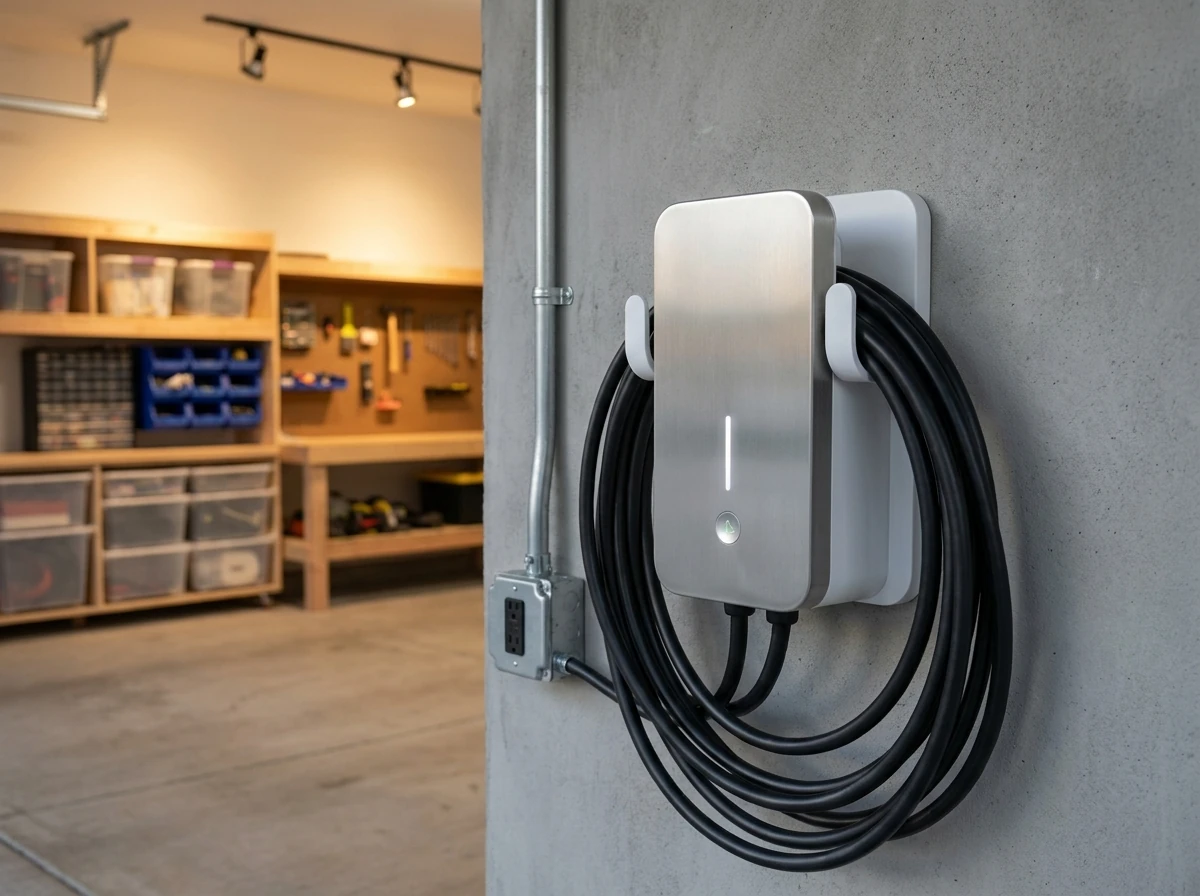
The panel-readiness assessment: start here before buying a charger
A Level 2 EV charger draws 40 to 50 amps continuously on a dedicated 240-volt circuit. That is a significant load — roughly equivalent to running a clothes dryer nonstop for 8 hours every night. Whether your Springfield home can handle it depends on what panel you have and what else is already drawing from it.
The load calculation — NEC 220.82
We calculate the total connected load on your panel per NEC 220.82, then compare it against your panel’s rated capacity. The math tells us one of three things: you have room for the charger circuit as-is, you need to redistribute loads to free capacity, or you need a panel upgrade before the charger goes in.
In Springfield, the answer divides sharply by housing era. The 1950s-1960s North Springfield and Ravensworth homes almost always need a panel upgrade first. The 1970s-1980s West Springfield and Newington homes usually have capacity but need a breaker assessment. The 1990s+ Franconia builds are typically EV-ready.
The load-bearing fact: roughly 35 percent of Springfield’s housing stock cannot take an EV charger without a panel upgrade. That is the highest panel-upgrade-required share of any city in this wave. If you live in North Springfield, Ravensworth, or Kings Park, the EV charger conversation starts at the panel.
Springfield’s housing eras and what each means for your EV charger install
Three eras, three different starting points. Each one determines the scope and cost of your EV charger project.
1950s-1960s: panel upgrade required
North Springfield, Ravensworth, Kings Park, Springfield Forest — ~35%Original 60 to 100 amp panels, some still running fuse boxes. Cloth-insulated copper wiring in the earliest builds. These homes cannot safely add a 50-amp EV circuit — a full load calculation will confirm, but the answer is almost always a panel upgrade to 200A before the charger goes in. Overhead service from utility poles is predominant in these subdivisions.
What fails: the panel cannot absorb the continuous 50A draw. Adding a charger to a maxed-out 100A panel trips the main breaker or overheats bus-bar connections.
1970s-1980s: usually EV-ready with assessment
West Springfield, Newington, Saratoga, Kings Park expansion — ~35%150 to 200 amp panels (200 standard by mid-1980s). The panel capacity is typically adequate, but the breakers are 35 to 55 years old. A load calculation confirms whether the 50A circuit fits within the remaining capacity. GFCI absent in some 1970s-era bathrooms and kitchens — we address these as part of the install when code requires it.
What fails: aging breakers (worn trip mechanisms after 40+ years), not capacity. Breaker replacement may be needed alongside the EV circuit.
1990s-2000s+: EV-ready, logistics are the question
Franconia townhomes, Springfield Town Center condos, Newington Forest — ~30%200 amp panels with capacity for an EV circuit. The main concern is not electrical — it is parking access. Townhomes and condos face shared-garage constraints, conduit routing through common walls, and HOA or condo-board approval requirements. Dedicated parking vs. shared garage determines the wiring path.
What fails: nothing electrical, but the installation logistics in attached housing are more complex than a detached home with a garage.
Level 1 vs. Level 2: the overnight charging math for Springfield commuters
Springfield is a commuter community — Franconia-Springfield Metro, VRE, I-95/I-395. The average Springfield resident drives roughly 40 miles round-trip to work. Here is what each charging level means for overnight recovery.
Level 2 (240V / 40-50A) — the practical choice
- Adds approximately 25 to 30 miles of range per hour of charging
- A 40-mile commute recovers in under 2 hours — fully charged by bedtime
- Handles longer weekend trips, errands, and multi-driver households
- Requires a dedicated 240V circuit from your panel (the work we do)
- All four brands we install (Tesla Wall Connector, ChargePoint Home Flex, Wallbox Pulsar Plus, JuiceBox 40) are Level 2
Level 1 (120V / 12A) — the included cord
- Adds approximately 4 miles of range per hour — that is not a typo
- A 40-mile commute needs 10 hours of charging — you plug in at 6 PM and the car is ready at 4 AM if you are lucky
- No installation needed — plugs into a standard household outlet
- Adequate only for plug-in hybrids with small batteries or vehicles driven fewer than 20 miles per day
- Most EV owners who start with Level 1 call us within 3 months for a Level 2 upgrade
EV charger brands we install
Four brands, each with different strengths. All are Level 2, all are hardwired installations on a dedicated circuit.
Tesla Wall Connector
Review-validatedUp to 48 amps. NACS connector (Tesla native, now the US standard). Built-in WiFi for scheduling and monitoring. Our Google reviews specifically mention Tesla Wall Connector installations. Best for Tesla owners who want the manufacturer’s own charger integrated with their car’s software.
ChargePoint Home Flex
Universal16 to 50 amps (adjustable). J1772 connector (universal, works with all non-Tesla EVs; Tesla with adapter). ENERGY STAR certified. WiFi + app for scheduling. The most versatile option for multi-vehicle households where not every car is a Tesla.
Wallbox Pulsar Plus
UniversalUp to 48 amps. J1772 connector. Compact design — the smallest form factor of the four, which matters in tight garages and townhome installations. Bluetooth + WiFi. Power-sharing capability for homes with two EVs on one circuit.
JuiceBox 40
UniversalUp to 40 amps. J1772 connector. WiFi with Alexa and Google Home integration. Utility demand-response compatible — some utilities offer programs where the charger shifts to off-peak hours automatically. Solid mid-range option with smart-home integration.
Townhome and condo EV installations: what is different in Franconia and Saratoga
Approximately 30 percent of Springfield’s housing is townhomes or condos. The electrical work is the same — a dedicated 240V circuit from your panel to the charger. The logistics are different.
Attached-housing considerations for EV charger installation
Dedicated parking vs. shared garage: if you have a private garage, the charger mounts on your wall and wires to your panel. If you share a garage or park in a common area, the installation requires condo-board approval, metering for your unit’s usage, and potentially a longer conduit run from your panel to the parking space.
HOA or condo-board approval: most Fairfax County HOAs require notice or approval for visible exterior modifications. A charger inside a private garage may be exempt; a charger on a shared structure or common-element wall typically requires board review. Virginia law (Code of Virginia § 55.1-1823.1) limits HOA ability to prohibit EV charger installation, but process requirements (insurance, installation standards) still apply.
Conduit routing through shared walls: in townhomes with shared party walls (Franconia, Saratoga), the charger circuit cannot penetrate the party wall. The conduit routes from your panel through your own interior, then exits through your own exterior wall to reach the garage or parking space. This may add 10 to 30 feet of conduit depending on your unit’s layout.
The EV charger installation process in Fairfax County — six steps
Springfield is an unincorporated CDP within Fairfax County. All permits go through the county — no town-level overlay.
Load calculation
We calculate your panel’s total connected load per NEC 220.82 to determine whether the 50A EV circuit fits within your current capacity.
Panel assessment
If the load calc shows insufficient capacity, we quote a panel upgrade as part of the project. If capacity exists, we identify the breaker slots and verify the bus bar condition.
Permit via Fairfax County PLUS system
We pull the electrical permit through the county’s PLUS portal at plus.fairfaxcounty.gov. Fairfax County Department of Land Development Services — Building Division handles the inspection.
HOA / condo approval (if applicable)
For townhomes and condos: we provide documentation for the board review — charger specs, mounting location, visual rendering. Work does not start until approval is in hand.
Installation
Dedicated 240V circuit from panel to charger location. Hardwired mount (not plug-in). Conduit routing as needed. Typically a half-day job for a detached home, potentially a full day for a townhome with a longer conduit run.
Inspection and activation
Fairfax County inspector verifies the installation. We walk you through charger setup, scheduling, and any smart-home integration. You charge that night.
EV charger incentives: what is available now
The incentive landscape changed on June 30, 2026. Here is the current status of the programs that apply to Springfield homeowners.
Federal and state programs — current status
Federal EV charger tax credit (IRC §30C / Form 8911) — this credit provided up to 30 percent of the cost of qualified alternative fuel vehicle refueling property. It expired on June 30, 2026 and is no longer available for new installations. If you installed and placed a charger in service before that date, you may still be able to claim the credit on your 2026 federal return — consult your tax advisor.
Dominion Energy residential charger program — Dominion has offered programs supporting residential EV charger adoption in Virginia. Program availability and terms change periodically. Check dominionenergy.com or call Dominion for the current offerings available at your Springfield address.
Virginia Clean Cars Act — Virginia follows California’s Advanced Clean Cars II standards starting model year 2025, which increases EV adoption across the state. This does not provide a direct financial incentive for charger installation, but it means more EVs on Springfield roads and more demand for home charging infrastructure.
About Mohammed Salahuddin — Master Electrician
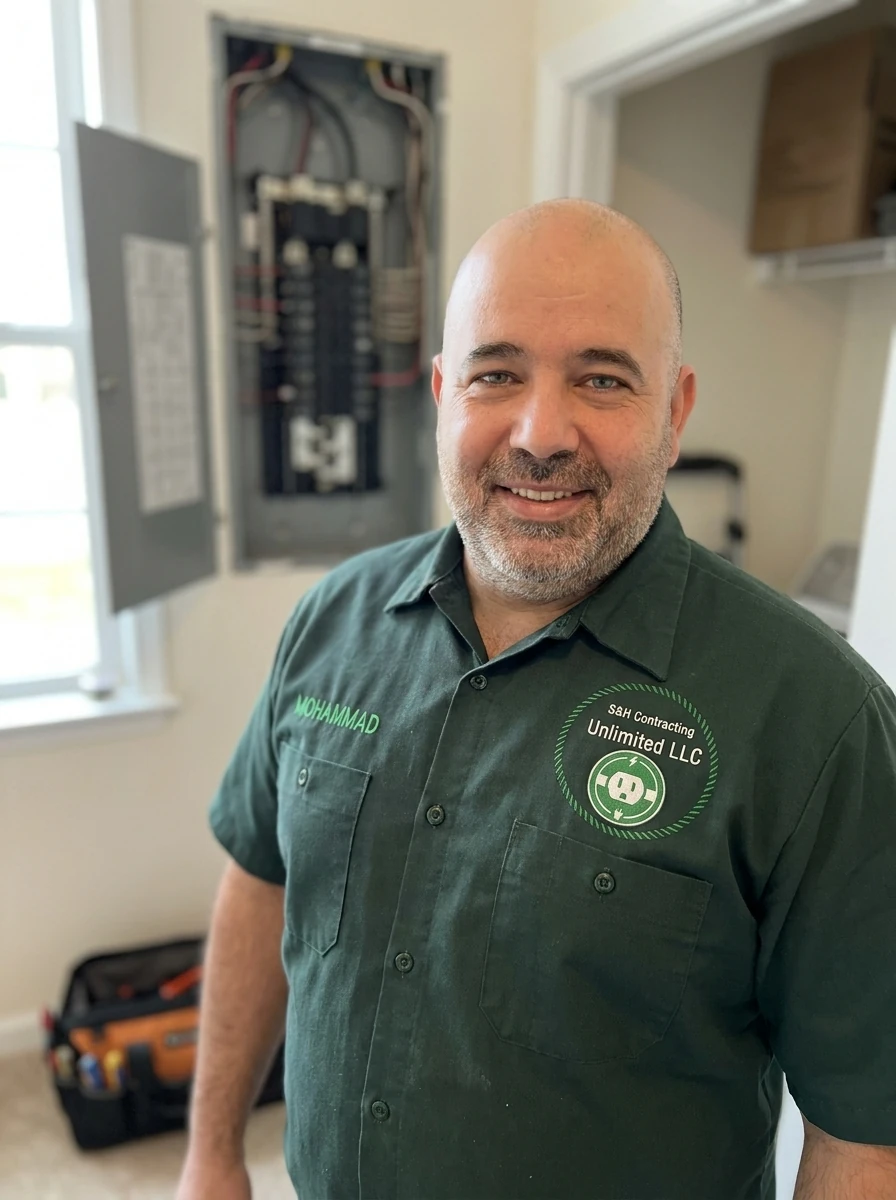
Mohammed Salahuddin holds a Virginia Master Electrician license — the highest tier the state issues. Sixteen-plus years in the trade, covering residential and commercial electrical work across Northern Virginia. He runs a fully insured maintenance team out of Woodbridge, which puts Springfield approximately 18 miles and 25 to 35 minutes away — inside the standard service radius.
Mohammad’s Google reviews mention Tesla Wall Connector installations specifically — real EV charger work for Northern Virginia homeowners, not just an add-on to an HVAC contract. The diagnostic-first approach means you get the load calculation and panel assessment before any charger commitment, so you know exactly what the project involves and what it costs.
S&H Contracting Unlimited is rated 5.0 stars across 77 Google reviews (re-verify count at publish time). Read more about our team.
Springfield neighborhoods we serve for EV charger installation
- North Springfield — 1950s Edward Carr ramblers; 60-100A panels, panel upgrade almost always required
- Ravensworth — 1950s-1960s split-levels; similar panel constraints to North Springfield
- Kings Park — 1960s; overhead service, aging panels
- West Springfield — 1970s-1980s; 200A panels, usually EV-ready with assessment
- Newington — 1970s-1980s; similar profile to West Springfield
- Saratoga — 1970s-1980s; townhome HOA considerations for charger placement
- Franconia — 1990s-2000s townhomes and condos; EV-ready but condo-board logistics apply
- Springfield Town Center area — newer condos; attached-housing charger logistics
We also serve Lake Ridge, Woodbridge, and the broader Northern Virginia region for EV charger installations.
Related electrical services
An EV charger installation often connects to panel work. If your panel needs upgrading first, we handle the full project — same electrician, same permit.
EV charger installation questions — Springfield, VA
How much does EV charger installation cost?
The cost depends on your panel capacity, the distance from the panel to the charger location, whether a panel upgrade is needed, and the charger brand. In Springfield, the biggest variable is housing era — a 1950s North Springfield home with a 100A panel needs a panel upgrade before the charger goes in, which adds to the project scope. A 1990s Franconia townhome with a 200A panel and a garage may need only the dedicated circuit. We provide a written estimate after the diagnostic visit — the visit is free.
Do I need a panel upgrade for an EV charger?
If your Springfield home has a 200A panel with available breaker slots, probably not. If you have a 100A or 150A panel — common in North Springfield, Ravensworth, and Kings Park homes built before 1980 — you almost certainly do. A Level 2 charger draws 40 to 50 amps continuously. We run a load calculation per NEC 220.82 to give you a definitive answer, not an estimate.
Do I need a permit for an EV charger in Fairfax County?
Yes. A new 240V dedicated circuit requires an electrical permit from Fairfax County Department of Land Development Services. Springfield is an unincorporated CDP within Fairfax County — all permits go through the county’s PLUS system at plus.fairfaxcounty.gov. We pull the permit and schedule the inspection as part of the installation.
Level 1 vs. Level 2 — which do I need?
For most Springfield commuters, Level 2. Level 1 (standard 120V outlet) adds about 4 miles of range per hour. A 40-mile round-trip commute needs 10 hours of Level 1 charging. Level 2 (240V, 40-50A) adds 25 to 30 miles per hour and recovers that same commute in under 2 hours. Level 1 is adequate only for plug-in hybrids or very short daily drives.
Can I install an EV charger in a townhome?
Yes, but the logistics differ from a detached home. Townhomes in Franconia and Saratoga have shared walls that cannot be penetrated for conduit. The circuit routes through your own interior walls and exits through your own exterior wall. HOA notice or approval is typically required for visible exterior modifications. Virginia law limits HOA ability to prohibit charger installation, but process requirements still apply. We help with the documentation for HOA review.
Is the federal EV charger tax credit still available?
No. The federal EV charger tax credit (IRC §30C / Form 8911) expired on June 30, 2026. It is no longer available for new installations. If you installed and placed a charger in service before that date, you may still be able to claim the credit on your 2026 federal return — consult your tax advisor. Dominion Energy may have separate residential charger programs; check dominionenergy.com for current offerings.
Ready to charge at home in Springfield?
Free panel-readiness assessment. Written estimate before any work starts. Fairfax County permit and inspection handled from start to finish.
703-972-5571